Nature
 PUBLISHED


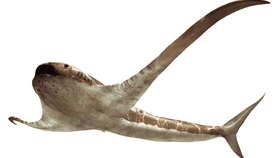


A glass-bottom boat during the Cretaceous would’ve been quite the epic day out, if not a little risky. As if mosasaurs and plesiosaurs weren’t cool enough, a new study published in the journal Science has unveiled another bizarre beast you might spot on such a trip: an eagle shark. Forget the feathers and the talons, these sharks are so named for their enormous wingspan, which in the studied specimen was wider than the shark was long.
The new species — known only from fossil evidence (better luck next time, eagle shark enthusiasts) — has been named Aquilolamna milarcae, and represents a new family in the history of sharks. A bit like manta rays, these eagle sharks were fitted with impressive pectoral fins — sort of like wings — which in the studied specimen spanned 1.9 meters (6.2 feet) despite the entire animal being just 1.65 meters (5.4 feet) long. The description may bring to mind a fearsome predator, but given its massive mouth and teeny tiny teeth, the researchers think it was most likely a filter feeder.
A. milarcae is thought to have been zooming around the ocean around 93 million years ago, joining the Cretaceous critters in the waters of the Gulf of Mexico. It shares some features with extant pelagic sharks, sporting a caudal fin (tail) with a well-developed superior lobe as seen in whale and tiger sharks. It therefore anatomically reads like a chimera, in combining traits of both sharks and rays.

Prior to this specimen’s identification and description, it had been thought that there was only one large plankton-feeding family scooping up food in the Cretaceous waters: the pachycormidae, an extinct group of large bony fish. The eagle sharks have now swooped in as second on the filter-feeding leaderboard.
The international research team led by Romain Vullo of the French National Centre for Scientific Research (CNRS) came across the complete specimen in Vallecillo, Mexico, back in 2012. The spot is known for its remarkably well-preserved ancient fossils, having delivered many ammonites, bony fish, and other marine reptiles to the hands of giddy scientists. Findings from the site have therefore been of great academic value as is this A. milarcae specimen, representing a new and little-known chapter in sharks' evolutionary history.


 1
1