Space and Physics
 PUBLISHED


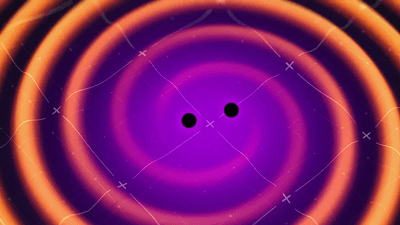


In the last 10 and a half years, the landscape of gravitational waves has changed dramatically. Just a decade ago came the first detection, and now, thanks to some very clear signals from black hole collisions, scientists can correct issues with detectors – something truly incredible.
The measurements conducted by the four gravitational wave observatories of the LIGO-Virgo-KAGRA collaboration are the highest precision measurements ever taken by humans. Two lasers are shot at 90 degrees from each other, bounce back on two mirrors at exactly the same distance, and come back to the sensors. With no gravitational waves, the lasers have covered the same distance in the same time. With waves, however, space-time is stretched and squeezed, creating differences in the path, and the two signals no longer match.
This all sounds very science fiction, even to me, and I'm working on this.
Dr Daniel Williams
The mirrors need to be placed with absolute precision, and they are attached to superattenuators, devices that can massively reduce the effect of any kind of vibrations. The system is so sensitive that it is affected by quantum mechanics effects, and it needs to be calibrated in a clever way.
“The way that we conventionally do this is that we introduce a small distortion into the detector deliberately,” study co-author Dr Daniel Williams, from the University of Glasgow, told IFLScience.
“We shine another laser onto the back of the mirror; the pressure from the photons slightly nudges it. We know exactly how much pressure we're applying; therefore, we can work out just how much it's going to move based on that pressure.”
From that test, they can calibrate the expected values for the actual lasers. “This all sounds very science fiction, even to me, and I'm working on this,” said Dr Williams.
As we have said, these are extremely sensitive devices, so when something is slightly off, it can lead to major errors. This happened twice recently.
The first case was related to the detection of the collisions between two black holes between nine and seven times the mass of our sun, more than a billion light-years away. It happened on September 25, 2024, and was named GW240925. The LIGO detector at Handford had a temporary error with the calibration.
“For the September 2024 event, we were able to see immediately something has gone badly wrong here in this detector,” Dr Williams told IFLScience.
The second time occurred on February 7, 2025. The same detector had just been switched on, and not all the monitoring software was up and running as it captured the merger of two black holes between 35 and 30 times the mass of the Sun around 600 million light-years from Earth. It was called GW250207, and it was the second loudest event ever recorded. Despite the issues with the detectors, the team was still able to use the data thanks to a process similar to autotune.
It's really quite exciting that we've gotten so good at making these detections that we can start to identify problems with the detector using colliding black holes.
Dr Daniel Williams
“Because it was so loud, we were able to use features in that signal,” Dr Williams told IFLScience. “We used the signal itself to work out what the correct calibration was.”
Cher pioneered autotune in her 1998 track Believe. What were gravitational wave researchers supposed to do? Just throw away the data? They can’t do that!
They had time to think it through and worked out that they could tweak the structure of the signals to overcome a couple of hiccups with the LIGO measurement. And after all was said and done, they fixed the problem in the data.
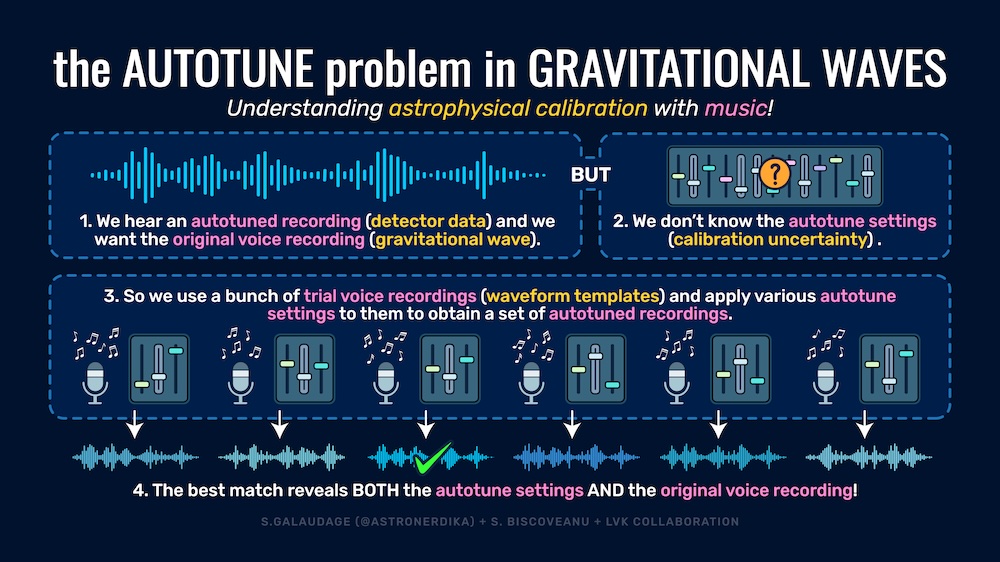
“If you are Cher, or whoever is applying autotune to your vocals, you know what the pitch is that you will want to hit, and then you want to slightly match that data, that recorded signal, to the thing which you expect it to be,” said Dr Williams.
Ten years on, the researchers know what the system should produce, and thanks to numerical approaches to general relativity, they know what the gravitational wave signal should look like. Combining everything, they were able to extract the actual signal and also the necessary correction for the detectors.
“The thing that I really liked about [the research] was that this wasn't really something we were expecting to be able to do,” Dr Williams told IFLScience.
“It was a slightly annoying coincidence that something went wrong with the detector and we had to then work backwards. But it's really quite exciting that we've gotten so good at making these detections that we can start to identify problems with the detector using colliding black holes.”
The study is available on arXiv and has been accepted for publication in Physical Review Letters.