Space and Physics
 PUBLISHED
 1
1



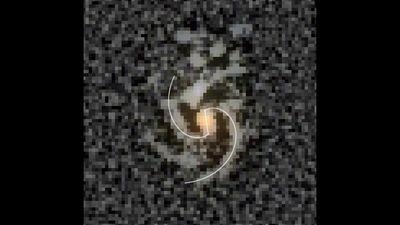


Galaxies did not emerge fully formed into the universe. They went through awkward, messy phases before they eventually settled into the forms that are more common in the universe. And yet, we have found some that look way too evolved to be so early, like seeing a baby that already looks very old. The latest weirdo seen is the earliest reported barred spiral galaxy.
Spiral galaxies are known for having most of their star organized in spiral arms in a flat disk. The core of the galaxy can be shaped like a ball or more like a bar. Our own galaxy, the Milky Way, is a barred spiral galaxy. Astronomers now report observations of the ancient barred spiral galaxy COSMOS-74706, the light of which has reached us from 11.5 billion years ago.
The object was spotted using JWST, and you can clearly see both the spiral structure and a central bar in the image above. The observations also provided spectroscopic analysis; the light of this galaxy was broken up in a rainbow, which allowed the recognition of the different chemical components as well as its redshift. The redshift is a shift in a galaxy’s light due to the expansion of the universe, and it can be used to work out how far a galaxy is. This one is pretty far.
“This galaxy was developing bars 2 billion years after the birth of the universe," Daniel Ivanov, a graduate researcher at the University of Pittsburgh, said in a statement. “Two billion years after the Big Bang. It's the highest redshift, spectroscopically confirmed, unlensed barred spiral galaxy.”
According to some models, some barred spiral galaxies were forming about a billion years earlier than this object, so there might be even older examples. That said, it is unlikely that they are very common.
“In principle, I think that this is not an epoch in which you expect to find many of these objects. It helps to constrain the timescales of bar formation. And it’s just really interesting,” Ivanov continued.
The formation of the bar can play a major role in the evolution of the galaxy as a whole. The bar can funnel gas and material towards the center of the galaxy, where the supermassive black hole resides. This allows the black hole to grow in bouts of feeding frenzies. This process produces a lot of energy, producing galaxy-wide winds that can dampen star formation.
The findings were presented at the 247th meeting of the American Astronomical Society.