Space and Physics
 PUBLISHED




Humanity has been on a long journey of discovering that the universe we find ourselves in is far bigger than we could possibly imagine. From discovering that Earth is not the only planet, to working out that those twinkling things in the skies are other stars, new knowledge has made us realize we truly are a tiny part of an extraordinarily large universe.
Whilst those were big moments (or, really, centuries of work) the biggest jump in scale came with confirmation of the existence of "island universes", confirmation of the breathtaking scale of the universe.
When we look up at the night sky using nothing but our feeble eyes, the vast majority of the objects we are seeing are stars, but not all of them.
Some are of course planets, whilst a small handful of nearby galaxies can also be seen on dark, moonless nights. Andromeda, our closest major spiral galaxy, was likely first documented by `Abd al-Rahman al-Sufi in 964 CE, describing it as "a little cloud" or, less flatteringly, a "nebulous smear".
Telescopes, when humanity finally bothered to invent them in the 1600s CE, revealed a lot more of these odd, now quite spiral-looking objects up there in the sky. Humanity did not yet know what they were, nor, crucially, how far they were from us.
Ahead of the discovery that would change everything, there were a number of competing arguments, which were pitted against one another in "The Great Debate" at the National Academy of Sciences in Washington on April 26, 1920.
Harlow Shapley of Mount Wilson took the view that the Milky Way was larger than we thought it was, and that they were "spiral nebulae" within it. Heber D. Curtis of the Lick Observatory, meanwhile, took the view that the "spiral nebulae" were in fact far more distant "island universes."
Shapley was correct in the end, but, as with a lot of things in science, it only looks the clear-cut better hypothesis in retrospect. Shapley's argument at the time, without the further evidence we were looking at, seemed pretty reasonable.
"The distances to the spiral nebulae were not known but Shapley argued that if the nebulae were placed well outside the boundaries of the Galaxy, as Curtis and others had suggested, the rotational velocities implied would be a substantial fraction of the speed of light," NASA's Robert J. Nemiroff and Jerry T. Bonnell explain.
"This was an unreasonable result and thus he argued that the real distances to the spiral nebulae must be closer to bring their implied rotational velocities in to a physically acceptable range."
While Curtis was right to suspect that these "nebulae" were actually spiral galaxies beyond our own, his model placed our Sun towards the center of the Milky Way, whilst Shapley placed it more accurately in the game of "pin the Sun on the spiral arm". Shapley was also correct on our galaxy being bigger than we thought, even if he overcooked it at 300,000 light years across, when now we think it is a mere 100,000 light years across.
Unfortunately for Shapley, those pesky and potentially faster-than-light rotation rates were down to a measurement error.
In order to settle the debate, what we needed was to accurately measure the distance to one of these "island universes".
Thanks to Henrietta Swan Leavitt, who studied thousands of variable stars in the Magellanic Clouds, we did know that a type of stars known as cepheid variables were useful in this regard, establishing a direct link between their pulsation period and their true intrinsic brightness. For example, stars with longer periods between pulsations were intrinsically brighter than those with shorter periods between pulsations.
With the known brightness of these objects, and the apparent brightness when viewed from Earth, you can then get a measure of how far the star is away from you, becoming known as a "standard candle" in astronomy. All we needed was to find these Cepheid variables in one of these "spiral nebulae" and we would know whether they were inside our galaxy, or much further away.
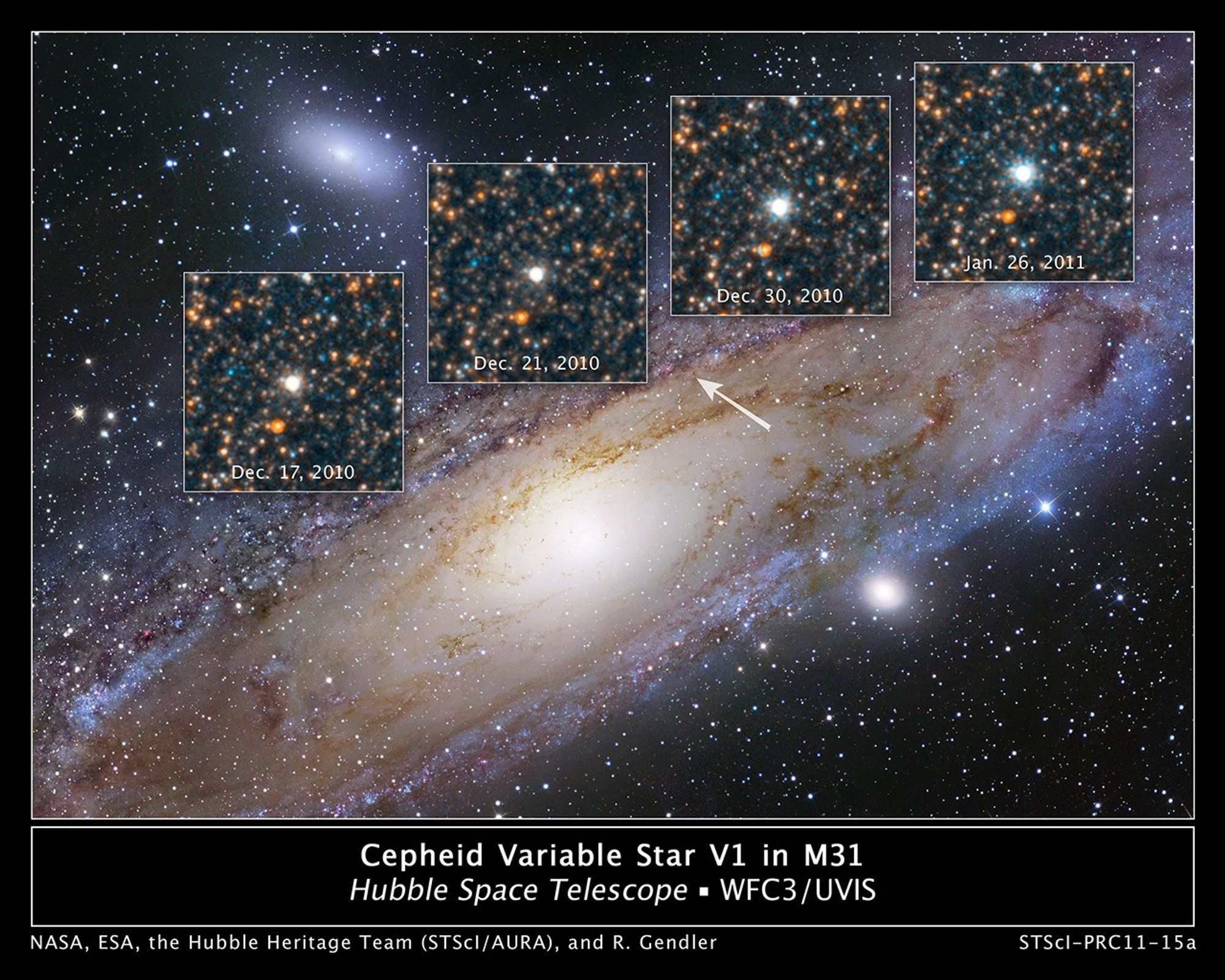
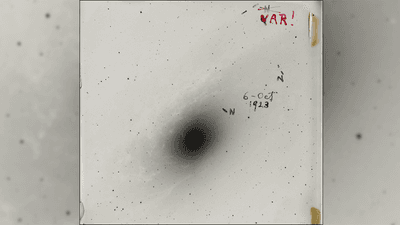
In 1923, Edwin Hubble turned his significant astronomy skills and the most powerful telescope of his time towards Andromeda in an attempt to find just that. On October 6, he was rewarded with three suspected novae, or exploding stars, labeling them all with an "N". Further observations showed that one of these, now known as V1, was precisely what he was looking for.
"Hubble obtained enough observations of V1 to plot its light curve, determining a period of 31.4 days, indicating the object was a Cepheid variable. The period yielded the star's intrinsic brightness, which Hubble then used to calculate its distance. The star turned out to be 1 million light-years from Earth, more than three times Shapley's calculated diameter of the Milky Way," NASA explains.
"Taking out his marking pen, Hubble crossed out the 'N' next to the newfound Cepheid variable and wrote 'VAR,' for variable, followed by an exclamation point."
Hubble's estimate turned out to be a little on the low side, with Andromeda being approximately 2.5 million light-years away. But, with discoveries of other Cepheid variables and other galaxies, it was the beginning of the end of the idea that the Milky Way is the extent of the entire universe. It is far, far far far100 larger than that.
After this, Hubble went on to discover that the universe is expanding, finding that galaxies that are further away from us are "redshifted" more than closer galaxies, implying that they are moving away from us faster than nearby galaxies. But it's not his fault for making us feel small, that's just the way the universe works.