Humans
 PUBLISHED


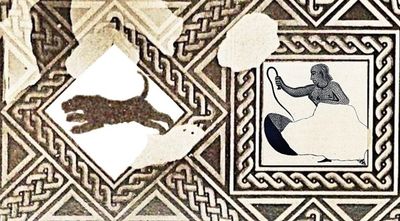


A Roman mosaic found in France depicts a topless woman battling a leopard with a whip, probably during an organized arena contest in front of a crowd of spectators. Until now, it was unclear if female combatants participated in these events, since no visual portrayals of such characters had ever been found.
In ancient Rome, men regularly fought against wild animals in spectacles called venatios. These male combatants were known as venatores – meaning hunters – although the existence of female venatrices is something that has also been hinted at in written sources.
For instance, the Roman historian Cassius Dio recorded the use of venatrices in games held during the reign of Emperor Nero, while the poet Martial described their participation in the inauguration of the Colosseum in 80 CE. All that had been missing was a visual depiction of an actual venatrix.
According to Alfonso Manas from the University of California, Berkeley, such an illustration can be found in a book composed in 1862 by the French archaeologist Jean Charles Loriquet. Within this volume is a drawing made by the author of a mosaic that was found two years earlier in Reims, which dates to the third century CE and appears to show a woman taking on a leopard.
Unfortunately, the mosaic itself was later destroyed by bombing during World War I, yet Manas says that Loriquet’s drawings appear highly consistent with the few surviving fragments of the original artwork. Interestingly, however, Loriquet himself seems to have been unsure as to the sex of the individual depicted in the mosaic, and suggested that this character may have played the role of an agitator, whose job was to annoy the wild animals in order to increase their ferocity in the arena.
In 2012, historian Kevin Kazek theorized that the person portrayed in the artwork was a type of gladiatorial clown known as a paegniarius, while also questioning whether they were a man or a woman. However, in his analysis, Manas points out that agitators probably didn’t actually exist and that the figure in the mosaic lacks the costume and weaponry associated with a paegniarius.
As for the fighter’s sex, the author states that “the topless character was thus depicted obviously to make it clear for the observer that she is a woman, by showing her breasts, that are rather prominent, especially the right breast, intentionally depicted as pointy.” He goes on to suggest that venatrices probably always fought topless in order to sexually arouse male spectators.
Noting that women were banned from partaking in gladiatorial combat against another person, Manas concludes that the woman depicted in the mosaic was probably a type of venatrix known as a succursor, or “helper”. As such, her role was to usher the leopard towards another venator, whose job was to slay the animal.
According to the researcher, this is “the first and only known image of a woman fighting beasts in the Roman arena,” and suggests that the ban on female gladiators clearly didn’t extend to venatrices who did battle with wild animals.
The study is published in The International Journal of the History of Sport.