Space and Physics
 PUBLISHED


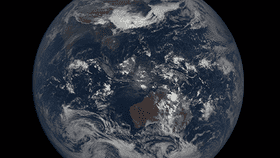


It's been a full year since NASA released the first images taken by its EPIC camera on NOAA's DISCOVR satellite, showing the sunlit side of Earth, and now they have released this amazing time-lapse video of what a year in the life of our planet looks like from a million miles away.
The video shows Earth as it spins over a period of one year, taken from DISCOVR's orbit at Lagrange point 1, where it is balanced between the gravity of Earth and the Sun, approximately 1.6 million kilometers (1 million miles) from Earth.
DISCOVR is a partnership between NASA, NOAA (National Oceanic and Atmospheric Administration), and the US Air Force, primarily used to provide data and real-time monitoring of solar wind activity that can act as an early warning system for potentially dangerous space weather events, or, as NASA puts it, as a "solar storm buoy" in space.
EPIC takes a photo every two hours, capturing the fixed features of Earth, such as deserts, forests, and oceans, as well as the ever-changing weather systems and clouds experienced by our blue planet. From this, data scientists can monitor Earth's atmosphere, ozone levels, ultraviolet reflectivity, vegetation, and even cloud height.
The DISCOVR team used more than 3,000 images to create this time-lapse video, so check it out here. We'd recommend watching it with the sound turned on.