Nature
 PUBLISHED


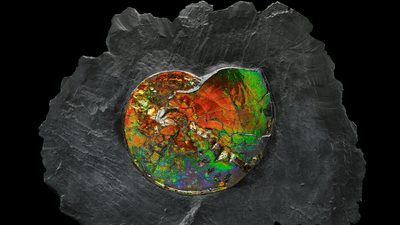


Lovers of all things colorful and sparkly are in for a treat with an unusual variety of ammonite that’s set to go to auction later this month. The “gem” of an ammonite dates back 71 million years, and comes with a curious coating of ammolite, giving it a dazzling rainbow iridescence.
“A 'Gem' Ammonite in Matrix from the Bearpaw Formation in Alberta, Canada dates to the Cretaceous some 71 million years ago and exhibits superb iridescence,” say Heritage ahead of their Nature & Science Auction taking place on November 20. “It is a top representation of the Placenticeras costatum variety, which accounts for less than 10 percent of the Ammonites found in the singular locality.”
According to the American Gem Trade Association, ammolite is one of the world’s rarest gemstones. Ammonite fossils have been found across the globe, but the gemstone variety has so far only been attributed to the Bearpaw Geological Formation in Alberta, Canada. It was classed as a gemstone by the World Jewellery Confederation back in 1981, and is relatively soft on the hardness scale with a Mohs of 3.5 to 4 – not to be confused with toughness, which is a whole different thing in the world of minerals.
“This extraordinary piece [weighs] 24 kilograms (52.8 pounds) and offers superb color and an incredible matrix in both size and shape,” says Heritage. “The vibrant fossil measures 10 inches (25 centimeters) at maximum diameter and is visually stunning with a myriad of vivid reds, oranges, golds and greens, as well as the rarer purples and blues.”
The ammolite ammonite joins a host of curious artifacts on sale at the Science & Nature Auction, including a 125-kilogram (275-pound) Siderite meteorite retrieved from a hotspot for meteorite hunters in Kansas. There’s also a fossil fish mosaic triptych from the Green River Formation Lagerstätte, Wyoming – with specimens dating back 50 million years – and a rare gold nugget from Alaska.
It’s been a big month for auction news, with a slice of mold medallion fetching a record-breaking $76,000 at Bonham's History Of Science And Technology sale on October 23. And who could forget the ground-shaking sale of Apex the stegosaurus? A dinosaur that went for an eye-watering $44.6 million at auction in July, topping the previous record holder – Stan the T. rex – by over $10 million.
Incredible stuff, but we might have to stick to the museum gift shops for now.



 1
1