Nature





Trying to find out more about the life of any wild animal comes with its own unique set of challenges. For researchers working in South America trying to study nocturnal tree-dwelling creatures, the challenges are harder than most.
That’s why a team of scientists created elevated platforms with camera traps to monitor the secret lives of these elusive creatures like never before, allowing them to spy on the nocturnal goings on of silky anteaters, ocelots, sloths, and porcupines.
The tree-living nocturnal mammals don’t make life easy for wildlife researchers. Often hidden by dense foliage high up in the canopy, the animals are just downright hard to see. This helps explain why these species are some of the most understudied mammal groups in tropical areas.
But without proper knowledge on their diets, breeding, and behavior, conservation work becomes harder.
Usually, surveys have to use binoculars to observe these arboreal species from the ground, but with the invention of camera traps more data can be collected from the tree canopy itself, especially when coupled with rope bridges and known feeding trees.
However, these systems are expensive and difficult to install, often requiring trained people to climb trees to fit them.
In a new study, researchers have used thermal imaging cameras as a potential solution.
Home security and drone technology have made thermal imaging cameras more affordable, and combining the tech with elevated platforms has allowed the team to study tree-top-dwelling mammals at night in Panama.
The researchers chose two sites in Cocobolo Nature Reserve, central Panama, that were 521 meters (1,709 feet) apart. One was in secondary forest next to a stream, and the other in primary forest. The team created a platform on which one researcher could sit with the cameras to survey the animals between 6:00 pm and 6:00 am for nine nights each.
“Once a mammal was seen via the thermal mode, the video was activated, and the mammal was followed until it passed out of view," explain the authors. "If needed, the unit was switched to night vision mode to aid identification. Although our primary focus was on arboreal mammals, ground-dwelling mammals were also recorded."
Over a total of 205 hours of survey time, the team recorded 651 observations of which 61 percent were nocturnal arboreal species and 20 percent were ground-dwelling species. In total, they observed 14 species clambering through the trees and wandering around on the forest floor.
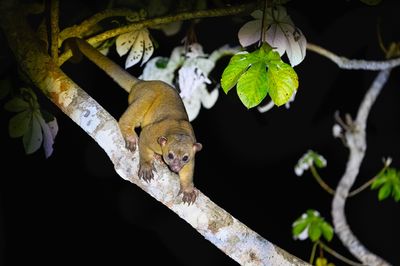
This included a very relaxed kinkajou lounging over a branch, a margay cat prowling through the leaf litter, a pair of Andean porcupines engaging in a midnight tryst, and a gorgeous silky anteater foraging its way through the canopy.
“The excitement of not knowing exactly what I’ll see keeps me alert and awake," study author Lucy Hughes told National Geographic. “It’s part of the magic.”
Most of the species were observed travelling, feeding or resting, though the team did also witness mating events. Since the animals carried out their typical behaviors, the researchers believe that at least some of the species were oblivious to the presence of the observers and their cameras in the canopy, or simply that the animals were not negatively impacted.
Overall the observer on the canopy platform using thermal imaging was an effective method for watching arboreal species with minimal disturbance to record behavior in dense vegetation at night. The team thinks that the cost and set-up are not prohibitive, and that the method could be used to discover more about these elusive mammalian species.
The paper is published in the Journal of Tropical Ecology.