Humans
 PUBLISHED


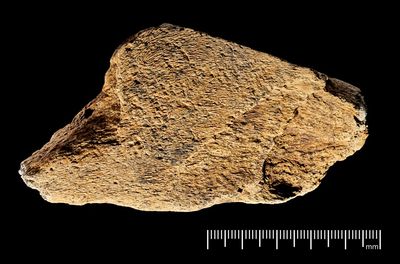


Hunter-gatherers in England used a tool fashioned from an elephant bone to sharpen their butchery utensils almost half a million years ago. We don’t know which human species used this proboscidean percussor, but the bone was probably employed to produce highly symmetrical axes that were significantly superior to anything that humans had manufactured anywhere in Eurasia up to that point.
The piece of bone was originally found at the famous site of Boxgrove in the early 1990s, yet its function had until now remained a mystery. However, using electron microscopy and 3D scanning, the authors of a new study identified a series of impact marks as well as tiny fragments of flint embedded within these scratches, indicating that the osseous object was used as a “retoucher” for refining stone tools.
Being softer than stone, bone is an excellent material for retouching flint, and the adoption of such percussors is thought to have been instrumental in enabling humans to produce higher quality flint tools. “The use of soft hammers and retouchers allowed for greater control in the knapping process compared to hard hammers, enabling early humans to produce more finely shaped and efficient tools,” write the study authors.
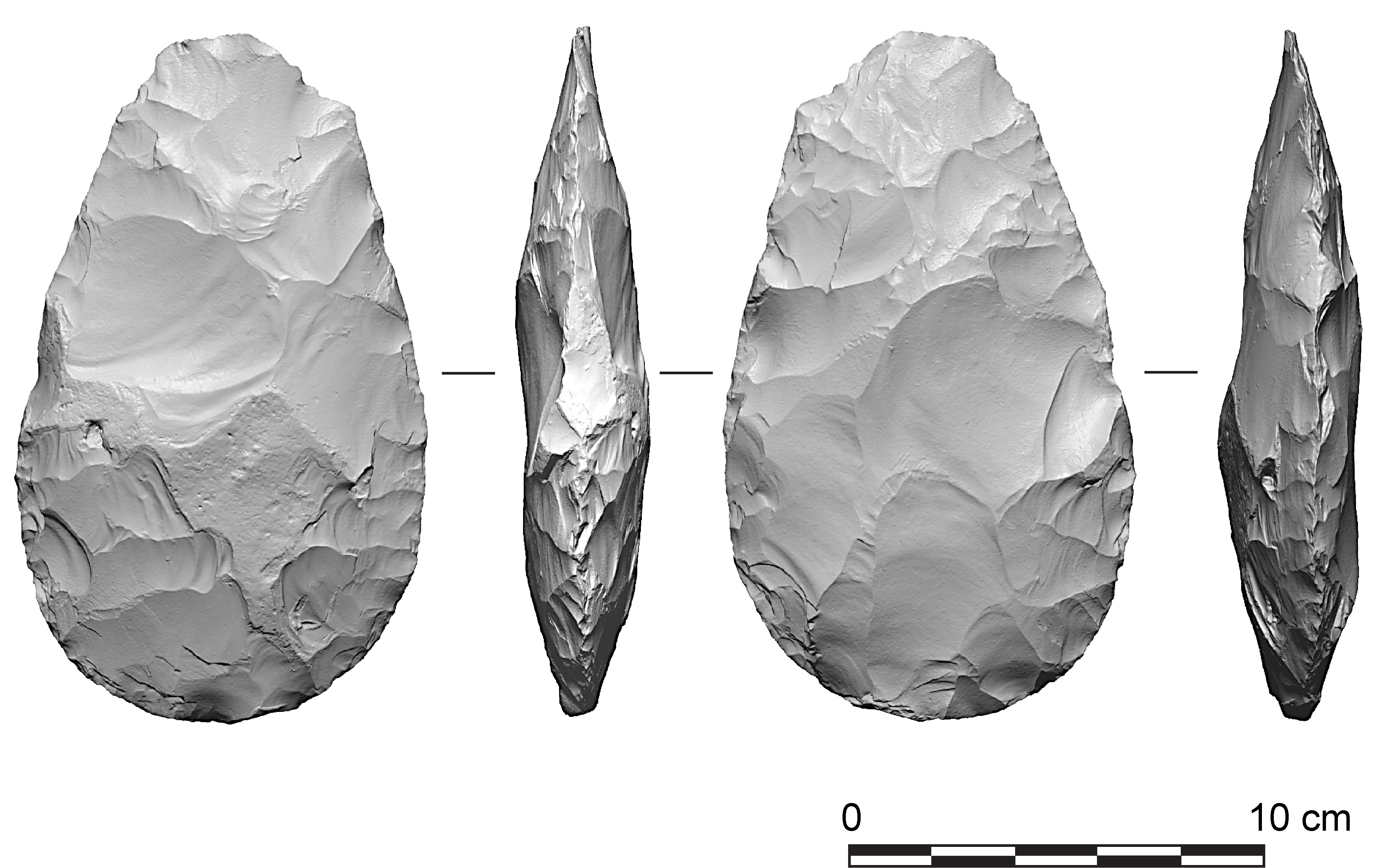
Dated to 480,000 years ago, the elephant-bone retoucher coincides with the emergence of finer handaxes at Boxgrove, representing the beginning of what is often referred to as the “second wave” of the Acheulean lithic industry. “The handaxes at Boxgrove are extremely symmetrical and their edges are very sharp,” says study author Dr Silvia Bello from the Natural History Museum in London.
“They are beautiful, and there is a very strong link between these refined tools and the use of this organic material, because to achieve this level of complexity in a stone tool you need a retoucher,” she told IFLScience. Altogether, this points to the fact that the hominins that produced the Boxgrove handaxes were capable of advanced knapping techniques and could also plan ahead by selecting the best tool-making materials from their landscape.
The elephant bone, for instance, was likely brought to Boxgrove from afar for the specific purpose of retouching flint blades. “No other elephant remains were found [at the site], so it is likely that this bone was brought in from somewhere else,” says Bello.
In terms of what all this means within the context of human evolution, the study authors write that “the transition from Early and Late Acheulean handaxes carries far-reaching behavioral and evolutionary implications, suggesting that they may have been made by distinct hominin groups with distinct technological and cognitive capabilities.”
And while the identity of these prehistoric humans remains unclear, Bello says that “they could be Neanderthals or Homo heidelbergensis.”
However, while this find represents the earliest known elephant-bone tool in Europe, older examples have been found in East Africa. Exactly how this advanced lithic tradition made its way to such a northerly latitude during the Lower Palaeolithic is something that Bello now hopes to find out.
“If [these tools] are in Boxgrove, they must be somewhere else as well,” she says. “They can’t appear in Africa and the UK with nothing in between, so this study is a call to action to say ‘let’s look again in other sites of a similar age to see if we can recognize this level of development’, which would have been essential to reach such a northern area and challenging climate.”
The study has been published in the journal Science Advances.