Space and Physics
 PUBLISHED



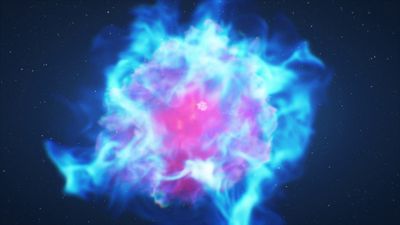


Superluminous supernovae are stellar explosions that are even brighter than your standard stellar death. They are at least 10 times as luminous as the average and can be many times brighter when viewed from Earth.
The source of this increased brightness isn't fully understood, and it might not even be a single mechanism. Some models put it down to the formation of a black hole; others suggest interactions with surrounding circumstellar matter (CSM). Another possibility is the formation of a neutron star, such as a highly magnetic magnetar.
In the case of SN 2024adtg, it appears a combination of two scenarios pushed it to become the third brightest hydrogen-rich supernova ever witnessed. Data from the event was presented today by Uliana Pylypenko at the Annual Meeting of the European Astronomical Society in Lausanne.
“This particular supernova, potentially, has quite an interesting powering mechanism, which is a central engine and circumstellar material interaction with ejecta,” Pylypenko, from the University of Turku, Finland, told IFLScience.
“This central engine can be, for example, a magnetar, which rotates very quickly, and as it spins down, it gives energy to ejecta or just also contributes to radiation. In the observation, we see the signs of both of these things.”
The explosion was billions of light-years away and so bright that the team was able to track it for about 200 days before it became too faint to see. The researchers were able to obtain the supernova's light spectrum and found evidence of an interaction between the ejecta, the material thrown away from the explosion, and the CSM, which already surrounded this object.
However, that alone couldn’t explain what they were seeing; the amount of interaction simply wouldn't be enough to power such a huge explosion. Something else would have been needed to push the energy of SN 2024adgt and allow it to become the third-brightest hydrogen-rich supernova known (it was the second-brightest when it was discovered).
“There are plenty of these hydrogen-rich superluminous supernovae where it's very clear from the spectra that there is this strong interaction between ejecta and circumstellar medium,” co-author Tuomas Kangas, also at the University of Turku, told IFLScience.
“This is easy to explain then: it's a normal supernova except there is just a huge amount of CSM, so a very strong interaction; that's what makes it superluminous. But here, it looks like that's just not enough.”
That’s where the central engine scenario comes in. A magnetar is a likely candidate. This is an object a bit more massive than the Sun compressed to a size smaller than a city. Magnetars possess such powerful magnetic fields that one placed halfway between Earth and the Moon would wipe all the credit cards on our planet.
“We don't see any specific signs of a magnetar itself,” Pylypenko told IFLScience. “Though the radiated energy is so huge that it can't be just like an explosion as in normal core collapse supernovae.”
“Studying supernovae in general helps us explain some massive star evolution, which has a lot of impact on pretty much everything in astronomy,” said Pylypenko. “Figuring out what powers these very rare, very, very luminous events can tell us something new about some potential progenitors or their new evolutionary paths.”
Given that superluminous supernovae are produced by massive stars that tend to be more chemically simple, understanding them also provides a window to the kind of supernovae that happened in the early universe, when stars were more massive and didn't have as many heavy elements as today.
So these large explosions are both utterly spectacular and very important to both stellar and galactic evolution, near and far.
Correction: An earlier version of this article incorrectly stated that this supernova was the third-brightest overall; it is, in fact, the third-brightest hydrogen-rich supernova.