Culture and Society
 PUBLISHED
 2
2


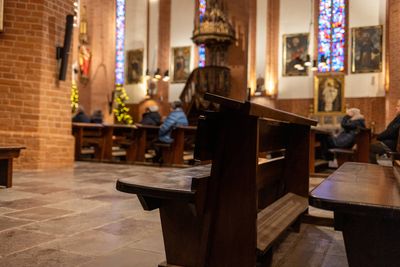


In 2025, the Bible Society, an international Christian advocacy group, published a report called The Quiet Revival, which made a claim that astounded and perplexed experts and the public alike. According to this report – which was based on the results of a YouGov survey – there had been a dramatic rise in Christian church attendance in England and Wales since 2018. What’s more, this surge in newfound faith was being led by larger numbers of young people.
Not everyone was convinced, however. Almost immediately after the report was made public, experts – both Christian and secular – began to question the methodology underpinning YouGov’s data. They drew attention to mounting evidence that online surveys are far from reliable, especially opt-in surveys where participants may be rewarded for their answers.
And yet the idea of the revival continued to be debated and circulated in the media. And while this coverage was often gently caveated (though not always), the overall message was clear: something spiritually important was happening in England and Wales. The discussion and debate continued throughout the year, but in March 2026, it all changed. To the dismay of religious communities who took the good news to heart, YouGov finally admitted that their survey was not adequate. A thorough review of the results revealed flawed data, leading them to retract the survey all together.
For its own part, the Bible Society admitted the error and retracted their own report, issuing a new one that attempts to make sense of what went wrong and its implications. Although the data does not support their views that there is indeed a revival of Christian faith in England and Wales, they nevertheless believe there is still enough evidence in their everyday experiences to remain hopeful.
Digging into the story of the “quiet revival”, how it was popularized and how it all collapsed, does not just tell us something about how data is (mis)used, (mis)understood, or (mis)presented in public domains. It also highlights real and present anxieties in our culture concerning secularization and the gradual loss of faith among more generations.
A rather loud revival
Before delving in to the murkier aspects of this story, it is worth looking into the details underpinning the original claims.
“In churches across society something amazing is happening, challenging long-held predictions about the future of Christianity in the twenty-first century. Where once we saw aging congregations and a steady decline in attendance, we see dramatic growth, led by the young.”
This was one of the statements made by the Bible Society in their original report. According to this report, having a Christian faith was not only being “normalised” in England and Wales, it was increasingly seen as “culturally attractive”. In 2018, only 4 percent of 18–24-year-olds said they attended church at least monthly. But by 2024, this had risen to 16 percent, with young men attending church rising from 4 percent to 21 percent in just six years, while young women had a more “modest” rise from 3 percent to 12 percent.
To say this sudden swell in churchgoing was akin to a cultural transformation would be an understatement. The YouGov survey showed that 12 percent of the population was now actively Christian, rising from only 8 percent in 2018. In terms of raw numbers, this was a growth of over two million people who were now seeking Jesus, rising from 3.7 million in 2018 to 5.8 million in 2024.
Among this staggering spike in church attendance was evidence that the faith landscape of England and Wales was also becoming more diverse. The report showed that just under one in five churchgoers were from an “ethnic minority”, while the number of Catholics and Pentecostals had significantly risen as well, from 23 to 31 percent and 4 to 10 percent, respectively.
“The Church is transforming before our eyes, and the figures presented in this report show the proof,” the report stated.
“This fact has implications both for civil society and for Christian denominations, networks and congregations. It is hard to overstate its importance both for our national self-understanding and for the Church’s understanding of itself.”
And yet all this evidence flew in the face of every other study and poll that considered this topic. If anything, else, the results undermined decades' worth of trends that all pointed in the same direction: that church attendance was dropping across the UK, year-by-year. For instance, the annual British Social Attitudes survey – probably the best and most reliable source for this topic – demonstrated that the number of adults in England and Wales who classed themselves as Christians and went to church at least once a month actually fell by a quarter between 2018 and 2023 (from 12.2 to 9.3 percent).
Even on a denomination basis, the same phenomenon was turning up over and over again. Yes, church attendance has increased since the COVID-19 pandemic, but it is still substantially lower than it was in 2019. Even other YouGov studies pointed to widescale decline in church attendance between 2015, 2022, and 2024.
Despite these issues, the Bible Society and multiple members of the British press grabbed hold of the narrative, as they celebrated a potentially reinvigorated Church. Discussions were held in parliament, and across the country church groups shared anecdotes of converted youths turning to Jesus. Far from being a “quiet” revival, the idea that there was an upturn in church attendance seemed to be shouted from every Christian community, be it from the pulpit or at Christian conferences and festivals.
Finally, they all seemed to argue, the nullifying influences of modernity, which had eroded individual purpose, meaning, and community for many, had forced people to return to the Church’s embrace again. That is, until the whole phenomenon was revealed to be an error.
A mistake made in good faith
Anyone watching this story play out in the public sphere over the last year may ask themselves how we ended up in this situation in the first place. Despite the hope and the hype, there were plenty of skeptical voices expressing doubts. Among them was David Voas, Emeritus Professor of Social Science in the UCL Social Research Institute. For Voas, there were several reasons why this story became so significant.
Firstly, it represented “good news” for a community that has, for decades, experienced consistent blows as society becomes increasingly secular.
Christians are in the ‘good news’ business – the root of the words ‘evangelism’ and ‘gospel’ is good news.
David Voas
“Much of the blame for the popularity of this [narrative] rests with all the church leaders and others who finally had some good news after decades where everybody accepted that declining church attendance was the story. Here at last was something that would be good news they could communicate and so latched onto it in a big way.”
The Bible Society enunciated this anxiety themselves when they first published the Quiet Revival report. They expressed that from “the sociological insistence in the 1960s that secularisation was inevitable and the new atheism of the 2000s, through to the more recent findings from the 2021 census showing the evident collapse of Christian identity, the story seems clear – Christianity, particularly active Christianity, is on the way out.”
“Christians are in the ‘good news’ business – the root of the words ‘evangelism’ and ‘gospel’ is good news,” Voas added. “That's what those words mean, etymologically. And so if you're a vicar or a religious leader or a Christian commentator, this is absolutely what you want to write about.”
But beyond this, there is a much broader issue concerning the public understanding of how statistics work, as well as overall (un)familiarity with the scientific method. For instance, when it comes to conducting sociological surveys, the gold standard for methodological practice focuses on what’s called random or probability sampling. This is where everyone in a population has a certain probability of being selected to take part in the survey.
“You do your random sampling, you approach individuals so they're not volunteering to be in the sample, and then you ask them if they will kindly complete this questionnaire. And once you do that, the laws of probability will enable you to say what the margin of error is or the confidence interval around your estimates and so on,” Voas said.
However, it is a slower and more expensive way to conduct sociological research. So, to get around it, some groups (such as YouGov and their competitors) use opt-in online polls where people can simply sign up to participate. And once you sign up, you can present yourself as anyone you like – you could say you're male, female, young, old, Muslim, Buddhist, or Christian, a Catholic, a Protestant, a Quaker, baker, or candlestick maker.
And these companies have no real way to verify that every participant is exactly who they say they are – any effort to introduce lengthy verification process, such as sharing ID, will put many participants off, and those who do agree may end up skewing the sample towards specific characteristics.
If you publish a paper now in a social science journal, you will be expected to make your dataset available to other researchers so they can attempt to replicate your findings. And I think that's a good thing generally.
David Voas
“I kind of get why they're reluctant to impose really strict ID controls,” Voas added. “But the upshot is that you can be some guy in a basement in Bangalore doing surveys via VPN in England saying that you're an 18-year-old who lives in London.”
This particular age group are notoriously difficult to enroll for social surveys, so someone claiming to be someone of that age living in London is much more likely to be added to an opt-in survey. This makes it all the easier for bad actors to influence results.
“It's increasingly a problem,” Voas explained, “because AI chatbots can now be trained to complete surveys and to avoid the checks that YouGov and others are trying to put into place. So now there’s an arms race between companies like YouGov that see their whole business model put into jeopardy by these recent developments while bad actors are deploying all kinds of sophisticated tools to make money doing surveys.”
This phenomenon is known to academics and researchers. There is actually an extensive body of literature addressing the issue, but it seems these problems have not yet been widely shared in mainstream discussions. Even educated journalists and commentators are not necessarily aware that these large-scale polls are subject to infiltration and distortion – though perhaps the Bible Society’s recent experience may be a valuable cautionary tale.
Another point of contention surrounding the Quiet Revival report is that, from its publication to its eventual retraction, YouGov refused to let anyone see the data it was built on.
“In scientific work, there's this whole movement towards open science,” Voas explained. “If you publish a paper now in a social science journal, you will be expected to make your dataset available to other researchers so they can attempt to replicate your findings. And I think that's a good thing generally.”
“Certainly, for something like what amounts to an opinion poll, that should be the case. Well, people like me have been asking YouGov for the last year to release the data, and they resolutely refused to do so.”
Now this is not to imply that YouGov were doing anything underhanded with this survey, but the inability to check the claims made in the final report against the data should prompt caution. The Quiet Revival was not a peer reviewed study, and so there was no chance for independent, disinterested eyes to spot any inconsistencies.
“I don't need to tell you that peer review is just a sort of basic expectation of decent social science. And if you don't do that it's not to say that the material is bad or that the manuscript isn't worthwhile, and it's not to say the peer review is perfect, but peer review does at least give you a chance to catch errors and problems before they start running around in the social ecosystem.”
This problem was made more acute by the Bible Society’s apparent refusal to debate or discuss their work with others.
“They basically refused any kind of public debate on this. So, we would invite them along to workshops and conferences and public meetings where they would be treated with respect and be given their slot to present their findings. That's kind of the way science works. They did not want to do any of that.”
Is the revival real?
Despite its retraction, the Bible Society and other Christian apologists still maintain that something is going on in the spiritual landscape of England, Wales, and elsewhere. In particular, anecdotal accounts concerning the growth of individual churches or an increased number of adults requesting baptisms are being held up as signs of change. However, these isolated points are still lost in the wider downward trends indicating that society continues to become more secular.
“The dominant trend continues to be what I now refer to as quiet quitting,” Voas said. “It's people who without any fuss are not getting married in church. They're not baptizing their children. They're not going to church, even if they were raised by churchgoing parents. And that's how generational replacement works and generational replacement is the motor of religious decline or secularization.”
Of course, the sudden rise in adults seeking baptism or joining churches across the UK, Europe, or the United States is interesting and worth studying, but in this context, this small spike is nothing compared to “10 times or 20 times as many adults who are not baptizing their children,” Voas stated. “It’s an invisible drain.”
But what about the nature of religious faith? If we accept that church attendance is declining, as all the evidence indicates, does that necessarily mean that there are fewer believers or are people, as Voas says, “believing without belonging”?
“A year ago, I had a paper published in a pretty high impact journal, Social Forces, called 'Invisible Secularity'. And there I looked at data on belief. This is just in the United States, but it actually showed a weakening of belief in God on a number of dimensions.”
The study found that Americans are, generation by generation, becoming less confident in the existence of God, less persuaded that God is active in the world and judgmental, less inclined to see God as important, and less likely to express consistent convictions. So, the claim that secularization may simply be masking forms of lingering, albeit unorthodox, belief does not stand up to the evidence.
Ultimately, despite what some may say, all of this taken together indicates that society is indeed becoming more secular with each generation. But the case of the Quiet Revival and its accompanying clamour also shows that there is still a great need for us to exercise skepticism and to interrogate claims, even if those claims seem like good news.