Space and Physics
 PUBLISHED
 2
2



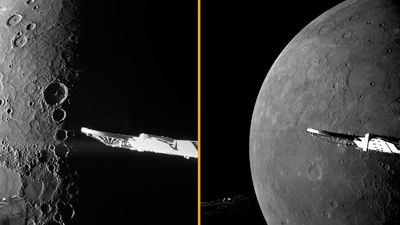


For BepiColombo, 2024 was a turbulent year. The mission is a joint project by the European and Japanese Space Agencies – ESA and JAXA – and a thruster problem forced the ground team to change plans for the probe's arrival into orbit around Mercury. After a risky maneuver in September, BepiColombo has now completed its final passage before the spacecraft enters into orbit around the planet next year, and has captured some stunning images in the process.
As has been standard procedure during its many flybys of the planet (six in total), BepiColombo has tested the instruments of the two spacecraft it is carrying. That includes cameras, which have revealed more of the intriguing landscapes that both the Mercury Planetary Orbiter (MPO) and Mio, the Mercury Magnetospheric Orbiter, will study in detail.
One location of major interest is the permanently shadowed floors of several craters at the north pole of the planet. Similar to the craters on the south pole of the Moon, portions of these geological features never see sunlight. Despite Mercury being so close to the Sun and having a negligible atmosphere, these locations have been suggested as places where water ice might reside.

Bepi took a great picture of Mercury’s terminator – the line between night and day – showcasing craters Prokofiev, Kandinsky, Tolkien, and Gordimer. Their rims cast permanent shadows on their floors and make the inside of these craters among the coldest places in the Solar System.
The passage highlighted many features that are located in the northern regions, such as Mercury’s largest expanse of smooth plains caused by an eruption of runny lava about 3.7 billion years ago. The Henri and Lismer craters were filled by that lava.

There is another lava-connected mystery hinted at in the pictures. The Caloris basin is the largest impact crater on Mercury spanning more than 1,500 kilometers (932 miles). The impact was so powerful that troughs radiated out from it. Out of one of these troughs, a boomerang-shaped lava plain is visible. But was the lava flowing out or in the crater?
As the lava plain demonstrates, younger features are brighter on Mercury. Why this is the case is another mystery. The composition of the planet is not fully understood and it will be up to BepiColombo to find out. It will enter orbit around Mercury in November 2026, with the science mission beginning in the following months.