Nature
 PUBLISHED


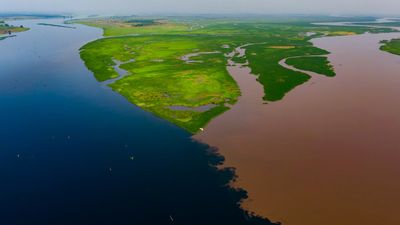


Researchers investigating peatlands in the heart of Africa – vast wetlands that have always been assumed to store carbon for thousands of years – have uncovered something worrying: a leak.
“Ancient carbon is being released via the lake[s]," said Travis Drake, a scientist in the Sustainable Agroecosystem (SAE) group at ETH Zürich and lead author of the new study, in a statement. “We were surprised.”
It’s concerning, not least because it might hint at a much bigger atmospheric chain reaction going on in the background. And here’s the real kicker: we don’t know how it’s escaping, or why – or what happens if too much gets out.
The Earth’s unsung hero
When you think of the Earth’s natural carbon sinks, chances are your mind goes to the mighty and imperiled Amazon rainforest or the increasingly acidic oceans. But often overlooked are the planet’s swamps and peatlands: those wet and waterlogged environments found around the world in which plants go to die – but not decompose.
“In peatlands, year-round water-logged conditions slow plant decomposition to such an extent that dead plants accumulate to form peat,” explains the IUCN. “This stores the carbon the plants absorbed from the atmosphere within peat soils, providing a net-cooling effect and helping to mitigate the climate crisis.”
And the extent to which these wetlands help to mitigate humanity’s relentless attack on the climate can’t be overstated. These areas aren’t huge – they add up to only about four percent of the Earth’s surface – but they store almost a third of the world’s soil carbon.
That’s twice as much carbon as is stored in forests – all of them, added up, to be clear. And peatlands do so much more, too: “They play a critical role in the water cycle by storing and filtering water, slowing peak flows, and reducing the impact of flooding,” notes the UN Environment Program’s World Conservation Monitoring Centre (UNEP-WCMC). “They also host unique plants and animals on which millions of people depend, and provide vital information on past environmental conditions within their peat layers that help predict future climate conditions.”
But despite their outsized role in the carbon cycle, swamps and peatlands remain oddly mysterious – not only to the public, as it turns out, but to the scientists who study them, too.
A surprise in the Congo
One of the biggest and most important of these wetlands, at least in the tropics, is in the Congo Basin. This huge region spans an area three times that of Texas, and it’s filled with everything you’d want in a “Best Of Earth” compilation: it’s home to the planet’s second-largest tropical rainforest; it’s a biodiversity hotspot, harboring gorillas, bonobos, forest elephants, leopards, and countless more species; and of course, it’s where the mighty Congo River and its many tributaries collect their water.
In among all that life, the swamplands can cut a striking image. Lake Mai Ndombe, and its neighbor Lake Tumba, are both what’s known as “blackwater” lakes – the water, darkened by millennia of dead plant matter, “resembles black tea,” the statement says.
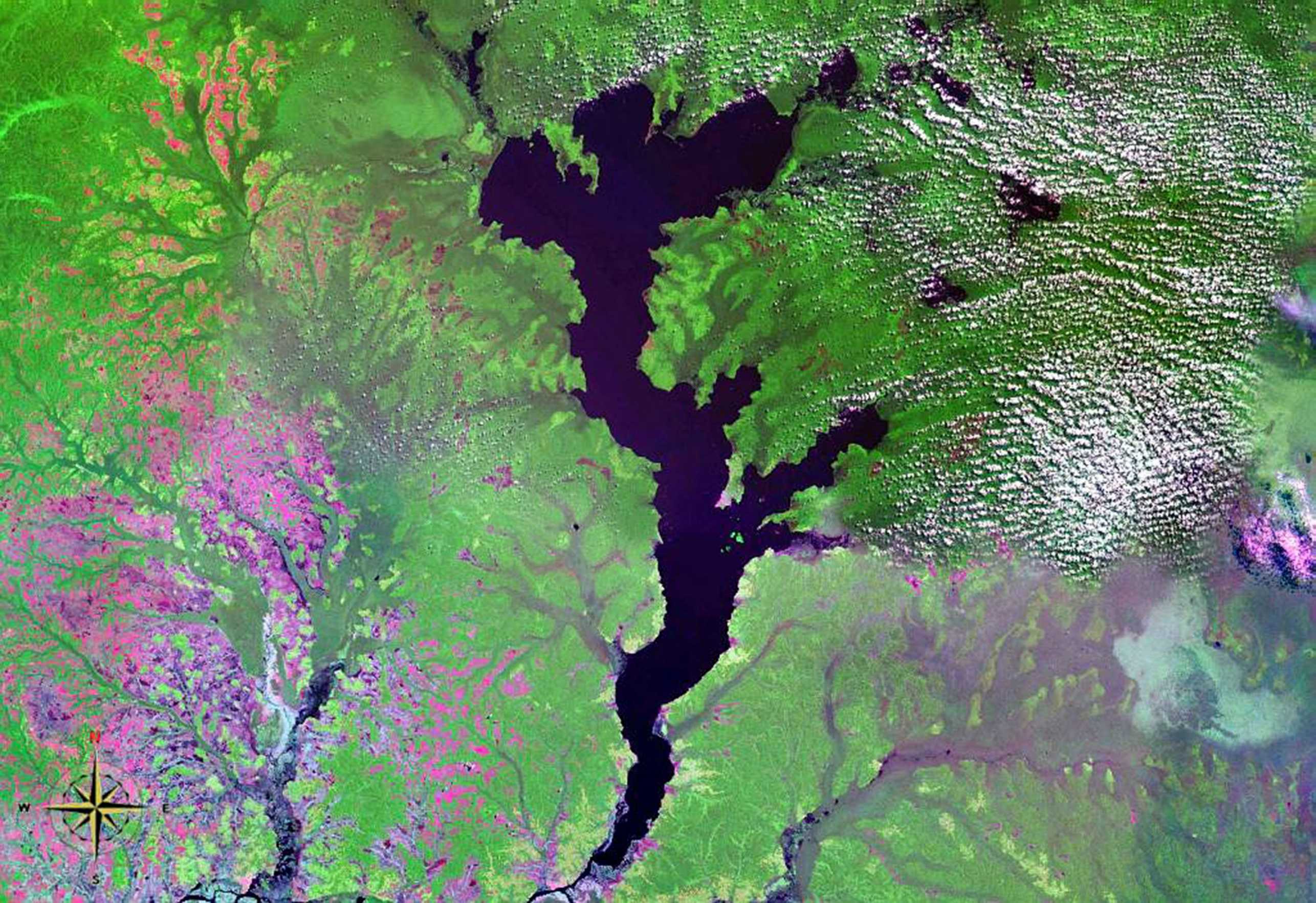
Until very recently, such areas were pretty much untouched by research – remote and inaccessible, the only ways to get there are by boat or pirogue, which makes studying them in person quite the undertaking. But now, having got there, the researchers have found something unexpected: vast amounts of carbon dioxide – about as much as would be emitted from driving a car 1,500 times around the equator of the Earth – being released from these two lakes each day.
It's as worrying as it is confusing. “It remains unclear just how the carbon is mobilised from the undecomposed plant material,” notes the statement. “The pathways by which the carbon enters the lake water are also still unknown.”
Even stranger is the discovery of which carbon is being released. Peatlands releasing carbon dioxide is hardly unheard of, but it’s almost always the fresh material that creates it – the ancient stuff, assuming no foul play from humans disturbing the area, is just too settled to leech out. But at Mai Ndombe and Tumba, upwards of 40 percent of the emissions appear to be from ancient peat. “The carbon reservoir has a leak, so to speak, from which ancient carbon is escaping,” explained Matti Barthel, a research technician in SAE and coauthor of the study.
That’s a problem, and not just because we need all the carbon sinkage we can get right now. Ancient carbon being released into the atmosphere from peatlands isn’t something we thought could happen – and as a result, the team doesn’t yet know for sure how or why it so obviously is. On top of that, there’s the implications for our current climate models: “This ‘lake-as-chimney’ mechanism may arise owing to the unique hydrological setting of the Congo Basin,” the team writes, “but if it is a more universal phenomenon, it may be occurring in other major peatland regions with large, integrated lakes (for example, Hudson Bay lowlands and West Siberian lowlands).”
“Either way, future work needs to reassess the stability of these critical systems and to incorporate this slow-cycle leak into global climate models.”
A five-alarm forest fire
Peatlands are responsible for carbon storage on a level that far exceeds their size and fame – so it’s fitting that their loss or destruction would have a similarly outsized effect on the climate.
“Emissions from drained peatlands are estimated at 1.9 gigatonnes of CO2e annually,” points out the IUCN. “This is equivalent to 5 percent of global anthropogenic greenhouse gas emissions, a disproportionate amount considering damaged peatlands cover just 0.3 percent of landmass.”
Unfortunately, what the team saw at Mai Ndombe and Tumba may be the first evidence of precisely that. The Earth’s climate is a delicate web, held together only thanks to countless unknown tipping points being triggered – but with the rapidly-warming atmosphere and increasing deforestation, our previously reliable peatlands might soon become our enemies.
“If droughts become longer and more intense, the blackwater lakes in this region could become significant sources of methane that impact on the global climate," explained Jordon Hemingway, Assistant Professor at ETH’s Department of Earth and Planetary Sciences and coauthor of the study. “At present we do not know when the tipping point will be reached.”
The study is published in Nature Geoscience.