Space and Physics
 PUBLISHED





Most of the rocks that fall from the heavens are tiny, ending up as meteors or fireballs, burning brightly in the sky in a more or less continuous fall. More serious objects are rarer, and the biggest of them all is larger than the rock that wiped out the non-avian dinosaurs 66 million years ago. Fortunately, we know where they are, and they are not getting too close to Earth. But just how many dangerous asteroids are there?
Size is not the only player when it comes to the long-term destruction produced by an asteroid impact. For example, two asteroids a few kilometers in size fell to Earth 35.65 million years ago, with an interval of just 25,000 years, without causing global devastation.
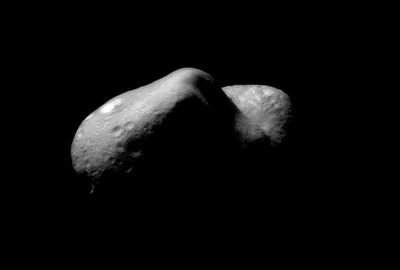
There are four Near-Earth Objects (NEOs) that have a diameter larger than 10 kilometers (6.2 miles); they are so big that they will likely be the end of us. While they are not a risk now, asteroids are influenced by the gravity of planets, and these objects have a 50 percent chance of becoming more dangerous within a billion years.
These four largest NEOs never cross the Earth’s orbit, so for now, they are not getting close enough to our planet to warrant the title of Possibly Hazardous Object (PHO). The largest is 1036 Ganymed, a stony asteroid with a diameter of approximately 35 kilometers (22 miles). Ganymed has a minimum orbit intersection distance (MOID) with Earth of 134 lunar distances or 0.34 astronomical units (AU), where one astronomical unit is the average Earth-Sun distance.
Now, an object with a MOID of less than 0.05 AU (which is 7.5 million kilometers, or 4.7 million miles) is considered a PHO. 1036 Ganymed has seven times that distance, so we are safe from this big chunk. Likewise, we are safe from the other three: 3552 Don Quixote, 433 Eros, and 4954 Eric. Don Quixote has a diameter of 19 kilometers (11.8 miles) and a MOID of 0.33 AU. Eros has a diameter of 16 kilometers (10 miles) and a MOID of 0.15 AU. Finally, Eric has a diameter of 11 kilometers (6.8 miles) and a MOID of 0.19 AU.
The largest, most dangerous known asteroid is 4179 Toutatis, with a mean diameter of 2.5 kilometers (1.6 miles) and a MOID of 0.0064 AU. That’s about 2.5 times the Earth-Moon distance. NASA estimates that we are missing just 5 percent of all NEOs larger than 1 kilometer (0.6 miles), but we are looking for them. Just a few months ago, we crossed the 40,000 known NEOs threshold. Still, many more are out there.
It’s not the planet-ending asteroids that most experts are worried about. It’s the city killers, those with a diameter of about 140 meters (459 feet), that could cause local destruction, rather than global. We have found almost 12,000 out of maybe 25,000 such objects. There are a lot of them missing, making them a serious danger.
We have demonstrated that we can move an asteroid, thanks to NASA’s DART mission. But NASA officials have recently said we can’t stop near-earth asteroids. The issue is that we have not got another DART mission ready to go. The only way we can protect ourselves now is if the threat presents itself with ample lead-up time. Astronomers continue to look, so let’s hope that they do not find anything dangerous!