Space and Physics
 PUBLISHED


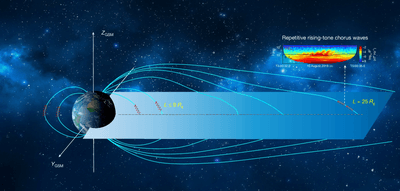


Electromagnetic chorus waves once thought to only exist close to the Earth have been found at a distance of 165,000 kilometers (102,526 miles) from us. Although that is still less than half the way to the Moon, the discovery indicates this chorus of rising-tone waves may exist far from any planet.
“Chorus waves” is the name given to bursts of electromagnetic radiation that, when converted to sound, reminded scientists of the dawn chorus of bird chirps. Whether you have the same response might depend on the type of birds in your neighborhood, but the name stuck. They’re far from the only poorly understood natural electromagnetic emissions we have found in space, but are among the strongest, leading to intense study.
Chorus waves are very brief, lasting less than a second, but they contribute to the formation of the radiation belt around the Earth that acts as a protective mechanism, and shape auroras and deflect electrons to strike the atmosphere. Since they align with Earth’s magnetic field, chorus waves were thought to be a local phenomenon, resulting from some planetary influence, probably the field itself. They’ve also been found near other planets, indicating their cause is not strictly Earthly. It was thought they might be restricted to areas within 10 times a planet’s radius and formed over the equator.
However, the distinctive rising tone of chorus waves has now been detected much further away by NASA’s four Magnetospheric Multiscale Satellites (MMS). The detected waves last just 0.1 seconds, and their frequency rises by about 100 Hz a second, similar to those detected closer to the planet. Although a larger sample of locations would be useful, that may mean that these waves occur in a much wider range of environments.
That said, the newly detected waves come not from some truly remote location halfway to another planet, but from an area known as the terrestrial mid-tail neutral sheet. This is on the opposite side of the Earth from the Sun, where the Earth’s magnetic field has become highly distorted. Indeed, this region doesn’t show the effects of the Earth’s magnetic dipole, which was thought to cause, or at least shape, chorus waves.
Based on the MMS observations, a team led by Dr Chengming Liu of Beihang University report the chorus waves interact with electrons in the area. It had been proposed these interactions would cause electrons to spiral, creating electron “holes” somewhat analogous to those of semiconductors. Liu’s team managed to find one such hole.
The authors think the chorus waves are produced by thermal electrons with energies of around 3 kiloelectron volts. Although local electrons with energies in that range transfer energy to the waves, high-energy electrons can extract energy from them through a process known as relativistic resonance.
The study is published in Nature.