Nature
 PUBLISHED
 1
1


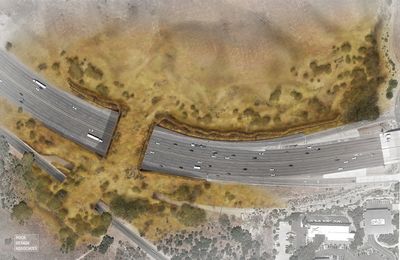


Over the last three years, a huge bridge has appeared across California’s Ventura Freeway – but this isn’t just any old overpass. This one is set to be the world’s largest wildlife crossing, and it’s being built with the aim of reconnecting some of the state’s most important animal life.
Known as the Wallis Annenberg Wildlife Crossing, the bridge will be 64 meters (210 feet) long and 52 meters (170 feet) wide, stretching across 10 lanes of the freeway in Agoura Hills. According to those behind the project, this will make it the largest wildlife crossing of its kind, and the first of its scale in an urban area.
The idea for the bridge arose out of research that identified declining genetic diversity in the Southern California population of cougars (also known as mountain lions). While other factors are involved, those behind the development of the crossing have said the main issue driving this decline is habitat loss and fragmentation – specifically, that caused by roads and development.
According to the Wallis Annenberg Wildlife Crossing website, “This leads not only to deaths from vehicle collisions […] but also multiple cases of first-order inbreeding (e.g., sibling to sibling, parent to offspring) because animals are not able to disperse in and out of the area.”
If allowed to continue, inbreeding can eventually lead to the extinction of a species – the lack of genetic variation that it leads to can make a population less able to adapt to changes in its environment.
“The wildlife crossing would provide the connectivity needed to fix this genetic collapse by allowing for the cats living north of the Santa Monica Mountains to travel into the range and for animals living south of the freeway to disperse out of the area,” reads the project website.
Work on the crossing began back in 2022, and in early April 2025, crews had begun putting down the first layers of soil. Once complete – currently estimated to be in 2026 – the bridge will be home to an abundance of native plant life that will help it to blend in with its surroundings, and it’s hope that all kinds of animals – not just cougars, but other wild cats, coyotes, birds, reptiles, and insects – will be supported by it.

“I imagine a future for all the wildlife in our area where it’s possible to survive and thrive,” said the crossing’s namesake, Wallis Annenberg, Chairman, President, and CEO of the Annenberg Foundation, in a statement. “This extraordinary structure will serve not only animals, but it will reconnect an entire ecosystem and protect this global biodiversity hotspot.”