Nature
 PUBLISHED


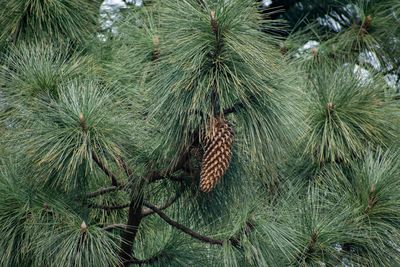


If you go for a walk in the woods you might be met with the rich smell of pine in the air, and even encounter pine cones on the forest floor. But just what are these structures for? What are they made of? And how big can they be? We break down the characteristics behind the cone.
A familiar woody pine cone is actually the female reproductive structure of the tree and contains the seeds. Most cones face down as they grow. Once they are mature, the winged seeds fall out and are carried away by the wind or animals. Some pine cones fall to the floor and protect the seeds until the perfect conditions arise, such as those of the narrowcone pine, which only open after forest fires.
The longest pine cone ever found measured 58.2 centimeters (22.9 inches) and was discovered in Cuyahoga Falls, Ohio by Steve Schwarz. This was a specimen from a sugar pine tree (Pinus lambertiana), known for producing long pine cones. The sugar pine is also the world’s tallest and largest tree by volume within the pine genus and is native to Oregon, California, and Baja California, Mexico. These trees can reach 40-60 meters tall (130-200 feet), while the cones are an average length of 30 centimeters (12 inches), making the record holder truly impressive.
While the long pine cones of the sugar pine are no doubt pretty spectacular, there is one more species that has a claim to a record. The heaviest pine cones come from a species called the Coulter pine (Pinus coulteri) and weigh a pretty hefty 0.4-2.2 kilograms (1-5 pounds) on average. But the heaviest one recorded weighed a whopping 4 kilograms (9 pounds), about the same size as a Pallas's cat.
Coulter pines are naturally found in California and Baja California, but have also been introduced in the British Isles, southern Europe, Australia, and New Zealand. Interestingly, the seeds of the tree are edible for humans but are not typically harvested for consumption.
This is also a fire-adapted species and could be at risk where fires are being prevented. On the flip side the IUCN suggests that fires that are too frequent could harm young plants and saplings, preventing them from reaching reproductive age. The Coulter pine is listed as Near Threatened while the sugar pine is listed as Least Concern.
Bizarrely – or maybe not, considering what can be a Guinness World Record these days – there is even a world record for the largest pine cone mosaic art piece. In 2013, an Albanian artist called Don Dominik-Skender Qerimi-Kukeli created a mosaic that featured over 53,163 pine cones.