


 Culture and Society
 PUBLISHED


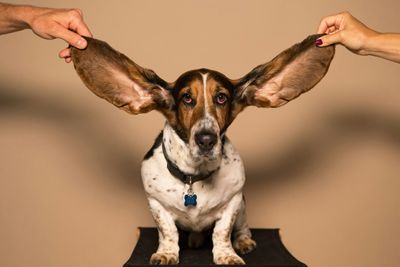


Most people will experience the so-called “bouba-kiki effect”, a psychological quirk in which our brains seemingly “hear” the form of shapes. And it turns out, dogs are just as susceptible.
A long reel of experiments has shown that most people are very likely to associate the word “kiki” with spiky shapes, while associating “bouba” with blobby, rounded ones. Take a look at the image below and see what you think.
It's a phenomenon that’s seen across many different cultures, regardless of their mother tongue. However, new research shows that it isn’t just humans who experience this psychological phenomenon.

The bouba-kiki effect – for dogs!
In a new study, scientists led by a team at the University of Parma in Italy have found that pet dogs spontaneously associate spiky shapes with “kiki” sounds and rounded shapes with “bouba”.
In one experiment, the researchers showed 51 dogs a wall with two different screens, one showing a round black shape and the other showing a black spiky shape. A recording of the sound “bouba” or “kiki” was then played 15 times over 30 seconds.
For the first 20 seconds, the dog was held in place by their owner while an AI model tracked where its eyes were looking. For the last 10 seconds, the dog was unleashed, and researchers recorded which shape it went to explore.
Lo and behold, the dogs were attracted to the round shape when they heard “bouba” and to the spiky shape when they heard “kiki”.
The researchers followed up with another study involving 19 more dogs, but this time the owners wore headphones playing loud rock music, so they couldn't hear the sounds. This was to rule out the “Clever Hans” effect, in which owners might unintentionally influence the behavior of animals.
Despite the new intervention, the results were the same: dogs appeared to associate the word “kiki” with spiky shapes and “bouba” with blobby ones.
Other experiments with bouba-kiki
But perhaps it shouldn’t be too surprising that dogs make these linguistic links.
Even baby chicks can demonstrate something comparable to the “bouba-kiki effect” just three days after hatching.
Remarkably, similar effects have even been demonstrated in people who were born blind, in kids who haven’t learned to read yet, and in cultures that don’t use written language.
It's a real puzzle for psycholinguists as it suggests there is some kind of innate, underlying structure behind human language and the naming of objects is not completely arbitrary.
But with non-verbal animals added into the mix, the “bouba-kiki effect” gets even weirder.
The new study is published in the journal Proceedings of the Royal Society B: Biological Sciences.



 3
3