Space and Physics
 PUBLISHED



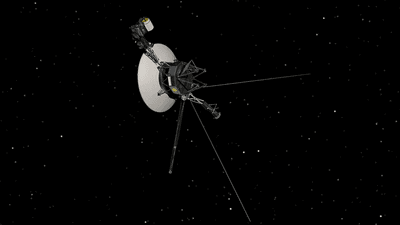


There are some sound waves moving through the Solar System and beyond. They are in the flow of the solar wind, the stream of charged particles from the Sun, as it passes around the planets' magnetic fields, and in the flux of interstellar material slamming into the edge of the heliosphere. And the most exciting thing is that we have been measuring them for decades, especially with the Voyager probes.
Some people have described these recordings as eerie. We must admit that we hadn't expected to hear Jupiter say “Surrender” in a Boston accent…
Only kidding; there is no message or recognizable sound in these signals, and the eeriness is in the ear of the listener. It's whistles and white noise, mostly. So, we can blame whichever composer decided to include theremin recordings in sci-fi movies if we ascribe anything alien to them.
How Can There Be Sound In Space?
Sound can't travel in a vacuum. Sound waves need a substance or material, a medium, to propagate. If space were a perfect vacuum, there would be no sound, but it isn’t. It has an extremely low density, and it doesn't remain constant but ebbs and flows with changes in solar activity. So, there are waves propagating in the interplanetary and interstellar plasma.
Usually, at Earth’s distance, the interplanetary medium is 3 to 10 particles per cubic centimeter. Vacuum enough that if we were to stick our head out there (in a non-deadly way), we wouldn’t hear anything. But there is still enough material for waves to propagate. And they can be speedy. At Earth’s orbit, the speed of plasma in the solar wind is about 50 kilometers (31 miles) per second.
What Did Voyager Record?
The trick to listening to these waves lies in recording the motion of the plasma. This has been done by many spacecraft, and it can be done even from the ground here on Earth. Some recordings made this way remain without explanation.
Since Voyager 1 and Voyager 2 traveled by the giant planets of our Solar System (all four for Voyager 2) and then into interstellar space, their recordings of those plasma waves have immense value. They provide important insights into the interaction between the solar wind and the planets, and between interstellar plasma and what we consider the zone of influence of the Sun: the heliosphere.
You don't have to have a PhD in planetary science or a detailed understanding of magnetic fields to get that something special is going on in these recordings. A crossing of boundaries, a change, a wave washing over the spacecraft.
Will Voyager Continue To ‘Listen’ To Interstellar Space?
All good things, unfortunately, have an ending. In August, the two spacecraft will have been in space for 49 years. These record-breaking explorers, the only two human-made objects that are in interstellar space, are aging. They weren't designed to live this long. To keep them functioning for as long as possible, the team maintaining them has had to turn off instruments over time. There might come a time soon when that isn't enough. The team isn't worried though.
"Once the Voyagers can no longer communicate with Earth, then they become our silent ambassadors. In about 40,000 years or so, each Voyager will pass relatively close to another star. We don't know for sure if those stars have planets, much less inhabited planets, but it's a chance for us to send our message in a bottle out into the cosmos,” Linda Spilker, Voyager Project Scientist, told IFLScience in an exclusive video interview.
Just a few weeks ago, the Voyager 1 team had to turn off another of its instruments to save power, but the plasma wave subsystem remains operational at the time of writing on both spacecraft. The mission is currently planning a major and possibly risky intervention to massively reduce power consumption and improve longevity for the two probes and their remaining instruments for many more years.

 1
1