Humans
 PUBLISHED
 7
7


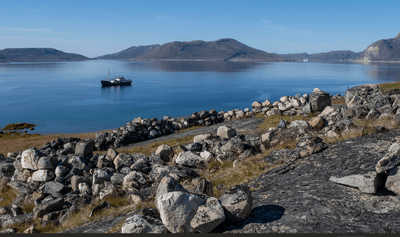


If there’s one thing we can say for sure about Vikings, it’s that they got around. In their adventures away from their Scandinavian homeland, they made it down to Spain and across the ocean to Canada – they even made it over to the Middle East. And then – in places like Greenland, at least – they left. And for a long time, nobody really knew why.
A 2022 study published in the journal Science Advances had the definitive answer for why the Vikings left Greenland – and it wasn't at all what people were expecting.
“Norse settlers developed the Eastern Settlement on southern Greenland in 985 CE,” explains the paper – yet “the region was largely abandoned by the early 15th century.”
“As some previous investigations note, this abandonment could have resulted from multiple issues, including climate change, management failure, economic collapse, or social stratification,” the authors write. “Southern Greenland was always near the limit of agriculture.”
Why did the Vikings leave Greenland?
So why did the Vikings, after over 400 successful years in the deceptively small and not in fact very green land, up sticks and leave? The prevailing theory until now was they just couldn’t handle the cold.
That’s not a diss against the hardiness of the Vikings – life literally was colder back then, as Earth had just entered a period of dramatic cooling now called the “Little Ice Age.” It wasn’t just a matter of putting a few extra layers on or throwing another log on the fireplace, either: the two-degree Celsius drop caused nothing less than a worldwide catastrophe, as researchers Ariel Hessayon and Dan Taylor explained in an article for The Conversation.
“Rivers and coastal seas froze, grinding trade and communications to a halt,” they write. “Crops and livestock withered while downpours spoiled harvests, unleashing widespread hunger and hardship.”
Greenland isn’t exactly known for its scorching summers, even today, so it would make sense that this Little Ice Age would spell the end for farming in the unwelcoming and ice-bound land. Geological evidence, like ice core data used to reconstruct temperature changes in Greenland through the centuries, seemed to support that conclusion too. It seemed like a cut-and-dry case.
There was just one problem.
“Before this study, there was no data from the actual site of the Viking settlements,” explained Raymond Bradley, University Distinguished Professor of geosciences at UMass Amherst and one of the paper’s co-authors. “And that’s a problem.”
While the evidence did indeed show that Greenland became too cold for agriculture during the Little Ice Age, it focused on a region a few thousand kilometers removed from where the Vikings actually settled.
“We wanted to study how climate had varied close to the Norse farms themselves,” Bradley said.
Temperature change wasn't the key culprit
That’s when the surprises started turning up. While there aren’t any suitable ice cores near the sites of the original Viking settlements, there was something just as good: a lake, just 9 kilometers from the tiny village of Qassiarsuk and with the rather unmemorable name of Lake 578.
Today, Qassiarsuk is… well, “tiny” is really underselling it: as of 2020, it had a population of just 39 people. A thousand years ago, though, it was called Brattahlíð, and it was home to some of the largest farms in Viking Greenland. That made it perfect for studying the changing conditions in the Norse settlements – and potentially figuring out why they were eventually abandoned.
“Nobody has actually studied this location before,” said Boyang Zhao, lead author of the study. So he and his colleagues spent three years patiently gathering sediment samples from the lake to analyze the temperature and water availability in the area over the past 2,000 years.
“What we discovered is that, while the temperature barely changed over the course of the Norse settlement of southern Greenland, it became steadily drier over time,” Zhao explained.
Those increasingly dry conditions would have been devastating for the Greenland Vikings. Even in good years, farming in the settlements had been hard: “in wintertime, cattle and some sheep and goats had to be kept in the warm dark byres,” the study explains, “and by spring, many cattle were too weak to move and the Norse farmers had to carry them out to pasture.”
In drought conditions, though, even this barely sustainable model couldn’t survive. Less rain meant lower crop yields, in turn meaning that farmers weren’t able to feed livestock over the winter months.
The end of a culture
Some turned to the sea for food, hunting marine mammals to replace the animals they could no longer raise on land – but that was far more dangerous than farming, and you weren’t even guaranteed a dinner at the end of it.
As food became scarce and insecure, and with rising sea ice threatening to cut the settlers off from mainland Europe, the fate of Viking Greenland was all but guaranteed, the study reveals.
Unable to manage the increasingly drier conditions, the settlers would have faced growing social instability until, eventually, they were forced to abandon their homes for if not warmer, then certainly wetter climes.
“The causes of Norse settlement abandonment are complex, and it is difficult to simply attribute them exclusively to climate change,” the study concludes.
“Nevertheless, our results highlight that the hydroclimate changes were tightly tied to the destiny of the Eastern Settlement.”
An earlier version of this article was published in March 2022.