


 Nature
 PUBLISHED




The Great Pacific Garbage Patch is an area of contaminated ocean split between two regions, one off the coast of California and another near Japan. The Patch is not a mountain of tin cans and old tires sitting on the ocean’s surface, but more like a thick soup of millions of plastic particles, trapped in the sway of large ocean currents called gyres.
Researchers exploring these manmade marine mishaps have found that many marine species—even those that normally live far away in coastal waters—have begun to call the Patch home.
For many years, researchers assumed that coastal-living marine animals wouldn’t last long in the open ocean, removed from their normal biome and food chain. One of the few ways that such species might end up far from shore is through rafting, where they hitch a ride on manmade or natural debris carried out by ocean currents.
Natural rafts, like vegetation or buoyant pumice rock, will degrade or sink shortly after taking to the open ocean.
Scientists realized that the plastics found in the Patch last much longer in the open ocean and set out to investigate which coastal creatures might be living there.
In 2018 and 2019, researchers hitched a lift on a ship organized by non-profit The Ocean Cleanup, which dredges the Patch with the aim of removing plastic from our seas. The researchers looked for chunks of material longer than six inches floating in the Patch’s plasticky broth. In total, they retrieved 105 pieces of plastic debris. Much of the material in the Patch is derived from shipping, and the haul included buoys, ropes, and nets.
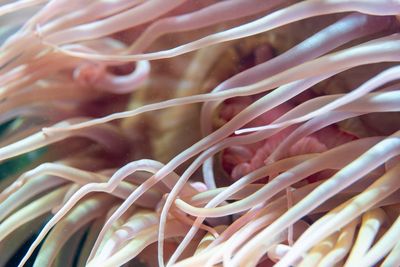
Back on shore, the team examined each hunk of plastic for signs of life. They looked for invertebrate marine animals, like mollusks and crustaceans. Their hunt turned up a rich, living world on these disparate pieces of flotsam and jetsam. The researchers found pelagic (ocean-living) species on 94.3% of the debris and coastal species on 70.5% of it. On two-thirds of the debris, coastal and pelagic animals shared space. These animals included simple bryozoans, tiny scavenging amphopods, sea anemones, sea sponges, worms, and sea slugs.
Overall, the team found 484 animals from 46 species on the debris, taken from six different animal groups. Overall, there were slightly more individual animals from coastal areas than from the deep sea.
The team next looked for signs indicating whether the animals were merely riding the debris to a new location or actively thriving in the ocean’s pull. They found brooding females, rich with eggs and young. The debris also appeared to contain animals at all life stages, including juveniles and adults. The authors concluded that the plastic passengers were reproducing and starting new communities in their new homes.
Many of the coastal species that the group found were asexual reproducers that spend their entire life cycle bound to surfaces. This would have helped the animals cope with their constantly shifting habitat.
Overall, the authors concluded that Patch garbage could be a rich source of marine life. However, they noted that the diversity was lower than that identified on debris swept away after the 2011 Tōhoku earthquake and tsunami. Some animal groups, such as molluscs, were unexpectedly absent from the Patch, whereas others, such as sea anemones, were more common than in tsunami debris. The authors say that their small sampling of the vast Patch likely doesn’t capture the biodiverse richness floating in the Pacific’s most polluted area.
In sum, the Patch may have unexpected effects on our ocean’s living world. “The plastisphere may now provide extraordinary new opportunities for coastal species to expand populations into the open ocean and become a permanent part of the pelagic community,” the authors wrote.
Their study was published in Nature Ecology & Evolution.

 1
1