Humans
 PUBLISHED
 4
4


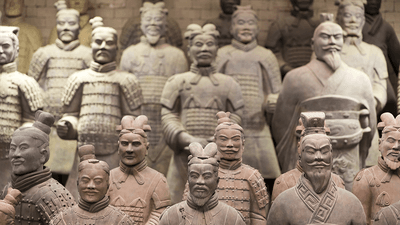


In March, 1974, a farmer, five of his brothers, and a helpful neighbor were digging a well northeast of Xi’an, the capital of China’s Shaanxi province, when they made one of the most astonishing archaeological discoveries of the 20th century.
Digging down into the Earth, they hit a statue of what they first assumed to be the Buddha. Investigations by archaeologists soon showed that was not the case. The farmer, Yang Zhifa, had hit one of an estimated 8,000 terracotta sculptures of soldiers, dating back to around 200 BCE.
The find was unexpected for everyone, not just the people who were expecting, at most, to dig a well. There are surprisingly few records of the Terracotta Army, as it is now known, despite the scale of the project, now known to be funerary art buried with emperor Qin Shi Huang in 210–209 BCE.
"Construction of the elaborate necropolis in Lintong, near Xi'an, Shaanxi Province, China, began when 13-year-old Qin Shihuang ascended to the throne in 247 BC, and was completed upon his death less than 40 years later," a paper on the topic explains.
"The workforce may have involved up to 700,000 craftsmen and labourers from all corners of the Qin Empire, some of whom were slaves who may have been executed once they had fulfilled their duties. Given that nothing of its kind appears to have existed previously in China, this project would have represented a monumental undertaking that presented numerous technological and logistical challenges."
Once excavated, the pits were found to contain thousands of life-sized soldiers (the average height of the warriors is 178 centimeters, or 70 inches), war horses, other animals, and esteemed officials. Their purpose is to "guard" the nearby mausoleum of Qin Shi Huang, and on that front they are doing a pretty good job. The tomb itself has never been opened to this day, over 2,000 years since it was sealed.
There are a few reasons why the tomb has never been opened, some of them practical, and some of them a little more Indiana Jones in nature.
On the practical side, one reason archaeologists do not want to open the tomb is out of fear of the damage they could do to it. When uncovering the first of the terracotta warriors, the lacquer beneath their painted faces curled within around 15 seconds after being exposed to the air. Instead, non-invasive methods of peering inside the tomb have been suggested, such as muon tomography (and cosmic rays) to model the site, but so far this hasn't been utilized.
Then there is the fear of booby traps.
"In the ninth month, the First Emperor was interred at Mount Li. When the First Emperor first came to the throne, the digging and preparation work began at Mount Li. Later, when he had unified his empire, 700,000 men were sent there from all over his empire. They dug through three layers of groundwater, and poured in bronze for the outer coffin," Chinese historian Sima Qian wrote of the tomb's construction around a century later.
"Palaces and scenic towers for a hundred officials were constructed, and the tomb was filled with rare artifacts and wonderful treasure. Craftsmen were ordered to make crossbows and arrows primed to shoot at anyone who enters the tomb. Mercury was used to simulate the hundred rivers, the Yangtze and Yellow River, and the great sea, and set to flow mechanically. Above were representation of the heavenly constellations, below, the features of the land. Candles were made from fat of 'man-fish', which is calculated to burn and not extinguish for a long time."
It is unclear whether these crossbows and arrows are inside the tomb, let alone whether they would fire at unsuspecting archaeologists 2,000 years in the future. However, the mercury mentioned in the account is plausible, after investigations of the atmospheric content of atomic mercury above the tomb mound found concentrations up to 27 ng/m3, significantly higher than background levels in the area.
"Highly volatile mercury may be escaping through cracks, which developed in the structure over time, and our investigation supports ancient chronicle records on the tomb, which is believed never to have been opened/looted," that team wrote in their study.
"Clearly, there are very large uncertainties in these estimations, but our findings add to the credibility of 2,200 year-old records by historian Sima on the existence of large amounts of mercury in the Emperor Qin tomb," they added.
For now, the tomb remains as sealed as it was thousands of years ago. But perhaps one day archaeologists will get a better look inside using scanning methods, before they risk the dual threat of crossbow fire and mercury poisoning, and learn more about this fascinating time in China's history.