Humans
 PUBLISHED
 1
1


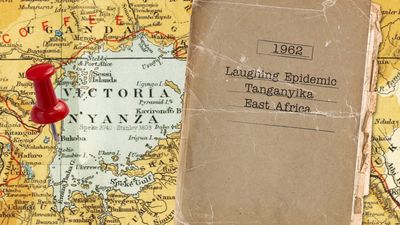


In January 1962, something peculiar happened to a group of girls living in a boarding school near Lake Victoria, Tanganyika (modern Tanzania): they began to laugh. This may not sound like a terrible experience – after all, we associate laughter with humor and joy. But this laughter was not an expression of mirth or merriment. In fact, anyone who reads the accounts of this laughter will quickly realize that something very disturbing was going on.
The laughter quickly spread through the school. Some girls laughed uncontrollably for a few minutes while others laughed for hours or even days (up to 16 days by some accounts), only pausing when they passed out. The laughter was also accompanied by crying fits, and some accounts even report students stripping naked and sprinting around the school grounds.
After a month of trying to control the problem, the school sent all the girls home, where the laughing was able to spread to other children and then to adults as well. Before long, many more people were gripped by uncontrollable laughter, restlessness, irritability, panic, and crying fits.
Doctors and scientists from across East Africa were brought in to help those afflicted by the strange contagion, which eventually affected over 1,000 people as it spread through local schools and then into other communities within a 160-kilometer (100-mile) radius. The Tanganyika Laughing Epidemic, as it was called, lasted for around 18 months before finally phasing out. No one died, but it left everyone involved asking questions about this unprecedented occurrence.
What caused this strange behavior? For decades, observers have routinely explained the epidemic as an example of mass hysteria. In essence, the people who found themselves unable to stop laughing were caught up in a psychological illness that presented with real physical symptoms. This collective response, so the story goes, was sparked by the country having recently gained independence from colonial rule, the political and cultural repercussions of which had sent psychological shockwaves through the African community.
But this explanation, as easy as it is to apply, is slightly awkward when it comes to this particular case. It is clear that the Tanganyika outbreak was indeed a collective psychological outbreak, but the use of the “mass hysteria” in this instance stemmed from beliefs developed during the colonial era to explain away African behavior. The case reveals much about a transitional period in which psychiatry, and broader ideas about how the minds of populations were understood, was undergoing profound change.
Contagious thinking
The term “mass hysteria” is quite a tricky one. Although it is still used with frequency to describe collective psychological behaviors, it is actually an historically specific diagnostic category with its roots in 19th century European psychiatry. It emerged from a tradition that associated psychological distress with emotional excess, suggestibility, and a lack of rational control. It was also typically applied to women, and racial groups who were seen as more likely to exhibit such behaviors.
Today, psychiatry and public health experts no longer rely on the concept of “mass hysteria” as a primary explanatory category. Instead, they tend to focus on what is called mass psychogenic illness (MPI) or mass sociogenic illness, which refers to the rapid spread of real, involuntary physical symptoms within groups of people with no identifiable organic cause. While the concept of mass hysteria was not formulated by any scientific methods, MPI is a legitimate object of scientific study – it is explored through epidemiological analysis and clinical observations, and is most often witnessed in groups who are experiencing extreme stress.
Crucially, the conceptualization of mass psychological events does not moralize or carry the prejudicial baggage that its predecessor did.
No laughing matter
The idea that the Laughing Epidemic was an example of “mass hysteria” is very much alive on the internet today. Most Google searches will present the story as a classic, uncomplicated example of this kind of mass psychological phenomenon. According to this reading, the children and later adults of Tanganyika had succumbed to the type of behavior that had been recorded in medieval and early modern European contexts. This diagnosis was made almost immediately after the events unfolded.
When two doctors – A.M. Rankin, Professor of Medicine at Makerere University College, Uganda and P.J. Philip, a Medical Officer for the Tanganyikan Government – appeared on the site at the Kashasha school, the place where the epidemic began, they initially tried to rule out physical infections or toxic causes. This involved tests such as lumbar punctures, biochemical analysis, and bacteriological examinations. When these came back negative, they turned their attention to the students’ food and water sources, just in case there were toxic substances that accounted for the odd behavior.
None of the students exhibited the types of symptoms the scientists would have expected to see if contaminated food were responsible. In particular, if the girls were being poisoned by the posho they ate, a staple East African food made of maize flour, then the scientists would have expected to see other symptoms such as dry mouths, fixed and dilated pupils, and muscular incoordination. And yet none of this was present.
“No foreign seeds were found in the maize samples taken. A toxic food factor could not explain the spread of the disease from one person to another,” the two doctors wrote in 1963.
With these other causes eliminated, the medical experts decided that “mass hysteria” was the most likely cause. In particular, they likened it to historical episodes such as the dancing manias that occurred in France, Italy, and Germany between the 11th and 17th centuries. In these cases, people would start to dance uncontrollably for long periods of time, a behavior that would then pass on to others who witnessed it.
Rankin and Philip then mentioned some lesser-known examples of mass hysteria, such as the 1787 case of a female cotton shop worker in Lancashire, England, who had “violent convulsions” after someone put a mouse down her neck. Apparently, the woman’s reaction caused others to have similar symptoms, because they imagined a potential illness coming from the cotton itself.
They then turned to other examples of mass hysteria cases seen in other contexts, such as Malaya (a former British colony where the Malay Peninsula and Singapore are today), cases of “Koro” in China (a cultural belief that a person’s genitals are shrinking, and that it will result in death), and what they referred to as “Arctic hysteria” in Siberia (likely a Siberian culture-bound syndrome recorded among Indigenous women).
The Laughing Epidemic, it seems, was to be understood in this context. A careful reading of these examples might start to hint at the issue that has lingered in popular interpretations ever since. It was compared to cases related to pre-industrial and Enlightenment incidents or selected cases of poorly educated cotton workers and non-European populations. All these people could be understood as being inherently “irrational” – medieval peasants, women, uneducated factory workers – and therefore prone to overactive imaginations in the eyes of contemporary, Western educated doctors.
Others offered similar interpretations. In 1964, a second investigation into the Laughing Epidemic was conducted by Benjamin Kagwa, a Ugandan-born psychiatrist who conducted neuropsychiatric tests that he presented alongside historical cases of mass hysteria mentioned above. The historian Yolana Pringle has made the case that Kagwa went a step further than Rankin and Philp by explaining the Laughing Epidemic in deeply prejudiced and racial terms.
This was the belief that colonial subjects, especially Africans, were inherently mentally unstable, even when healthy. Multiple generations of historians have shown that this assumption was the bedrock for many psychological theories produced during the first half of the 20th century to explain the minds of colonial subjects, especially when they rebelled against authority. According to this idea, when forced to experience Western education, Africans faced a form of “mental conflict” that manifested in various negative and sometimes violent ways (the Mau Mau uprising that precipitated Kenya’s independence from British rule was also regarded as another case of African acculturation).
These explanations ultimately armed colonial authorities with a means to dismiss African grievances or cultural behaviors as signs of their "backwardness". At the same time, it provided justification for continued colonial rule. Or to put it another way, if the Africans continued to act irrationally, then clearly they needed Western leaders to show them the way.
Viewed through this prism, the fact that the Laughing Epidemic occurred so close to the country gaining independence from colonial rule precipitated a regressive and primitive response – hence mass hysteria. By the time Kagwa was formulating this idea, these colonial views of the “African mind” were becoming less popular, but it nevertheless stuck. For more conservative viewers, the fact that this unprecedented psychological event had occurred so soon after the country gained independence would have been seen as confirmation of these long-held suspicions.
Over the coming years, psychiatry slowly moved away from these essentialized African ideas. This gradual transition occurred as psychiatry, anthropology, and psychology increasingly criticized the racialized and civilizational models of culture in favor of “transcultural psychiatry”, which affected a more sensitive perspective of mental illness that is shaped by culture.
So, did the Tanganyika Laughing Epidemic really occur? Absolutely. But the question is not whether the phenomenon was real. It is whether the enduring label of “mass hysteria” tells us more about the outbreak itself, or about the imaginations of those who tried to interpret it. The story of the epidemic survives today both as a medical curiosity as well as a reminder that diagnoses are never free from the historical worlds that produced them.