Space and Physics
 PUBLISHED


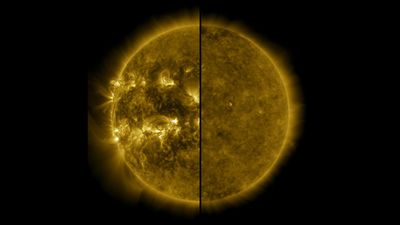


Astronomers have been studying sound waves moving within the Sun. This approach, known as asteroseismology or helioseismology can reveal insights into the internal workings of the Sun. Forty years worth of data on this solar “heartbeat” suggests that something is changing.
The Sun has an 11-year-long cycle of activity going from minimum to minimum. We are now just past the peak of Cycle 25, but the new study's data shows that since Cycle 23, the link between oscillation frequencies and traditional activity measures has shifted.
Cycle 24 was surprisingly weaker across the board, and while Cycle 25 appears weaker in surface indicators, it has been particularly strong and active. The seismic data confirms that.
Vibrations at low, mid, and high frequencies all seem to show a structural change within the Sun. Solar magnetic activity, the way the cycle manifests, is being squeezed into an increasingly shallow layer just under the photosphere, the visible surface of the Sun.
Data collected between 1987 and 2025 by the six telescopes of the Birmingham Solar Oscillations Network (BiSON) show these long-term changes to solar activity.
“The Sun has its own 'active biorhythm' creating rising and falling magnetic activity that shapes space weather. However, traditional surface measures don't capture the full story – that the Sun may be entering a different mode of behavior unfolding over decades,” lead author Professor Bill Chaplin, from the University of Birmingham, said in a statement.
“We have uncovered evidence of systematic changes in the solar activity cycle. Crucially, magnetic activity is becoming more tightly confined near the surface with each cycle. This is the first such discovery and would have been impossible without the long BiSON observations.”
Solar activity affects our planet and the space weather around it. A strong solar cycle might lead to many geomagnetic storms. Understanding the drivers of the Sun’s behavior is paramount for good forecasting.
“We discovered that the relationship between internal solar oscillations and surface activity has evolved over the past few cycles,” Professor Sarbani Basu, from Yale University, said.
“This trend cannot be explained simply by weaker magnetic fields. Instead, it indicates a structural reorganisation of how the Sun's magnetic activity is stored beneath the surface.”
Is this a long-term change in the Sun’s activity, or is it something that our star will walk back over the next few years? The team will continue to use BiSON across what remains of Cycle 25 and Cycle 26, which is expected to start around 2030, to find out.
The study is published in the Monthly Notices of the Royal Astronomical Society.