Space and Physics
 PUBLISHED
 2
2


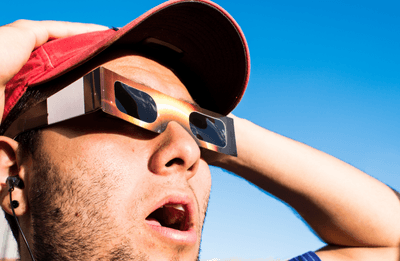


The 2024 North American total solar eclipse has come and passed. Now the spectacle is over, you might be wondering what to do with your solar eclipse glasses.
The next total solar eclipse to cross North America is predicted to occur on August 23, 2044. Unless you plan on hanging on to your protective glasses for two decades, you might be thinking about chucking them in the trash. However, it's possible for someone else to make good use of them.
Astronomers Without Borders (AWB) runs a program that collects used solar eclipse glasses and distributes them to people who may not otherwise have a safe way to view the eclipse directly. You can head over to their website for more information on how to participate and for the location of donation centers across the country.
“Because of the way these eclipse glasses are manufactured, they are not very eco-friendly, so they would potentially end up in the landfill. Let’s prevent that and put them to good use, and let others less fortunate around the world experience this wondrous celestial event safely," Andrew Fazekas, a spokesperson for AWB, told KUT Austin.
“It’s humbling to see so many organizations – big and small – coming together for this effort,” Fazekas added.
Following the "Great American Eclipse" in 2017, ABW sent tens of thousands of used solar eclipse glasses to South America, Asia, and Africa. The non-profit organization is now seeking donations to run the program after the 2024 total solar eclipse in North America.
It’s looking like 2024 eclipse will produce even more used glasses than the 2017 eclipse. Per NASA, an estimated 31.6 million people live along the solar eclipse’s path of totality this year, compared to 12 million in 2017. Let’s hope those millions of spectators followed the guidance and wore protective eyewear (and didn’t gaze directly into the Sun à la Donald Trump).
Bear in mind that you should double-check before reusing any solar eclipse glasses as some models can’t be used if they're more than three years old, according to NASA. After 2015, official solar eclipse glasses had to comply with regulations known as ISO 12312-2, ensuring this is no longer a problem. However, some older or “fake” models might not comply with these new rules.
To make sure your eclipse glasses are legit and follow the new regulations, look at the frame for an “ISO” mark or see the American Astronomical Society’s list of reputable vendors of solar filters and viewers.