Space and Physics
 PUBLISHED




Our planet is protected by a large bubble of plasma formed by the Sun that prevents interstellar ionizing radiation from flooding the solar system.
But where, exactly, the edge of this bubble sits is still not entirely known.
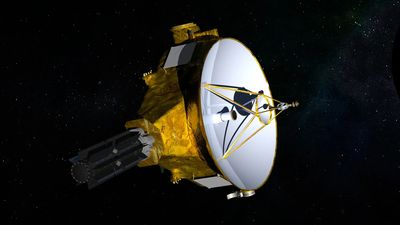
A pair of new studies are looking to define this boundary as NASA’s New Horizons spacecraft hurtles towards it. They have estimated that the spacecraft could hit the boundary any time within an 11-year window, and that it could actually pass in and out of it multiple times.
“We want to understand when the spacecraft will reach the termination shock to prepare to take measurements and download data about this region,” said Dr. Jonathan Gasser, lead author of the two papers trying to define the heliosphere’s boundaries, in a statement.
“Based on our research, we predict that New Horizons will encounter the termination shock as early as 2029 or as late as 2040. And it is possible that it could cross the boundary more than once as the heliosphere continues to expand and contract.”
This might seem like a wide estimate but there’s good reason for it, because the boundary of this bubble, known as the heliosphere, is in flux.
The heliosphere is formed by the solar winds ejected by our Sun as they flow outwardly into space.
These winds, made up of charged particles, including electrons, protons, and alpha particles, travel at an immense speed of around 1.6 million kilometers per hour (one million miles per hour), bathing everything in their path. It is these winds that are responsible for the dancing auroras and the stripping of Mars’ atmosphere.
But as the winds approach the edge of the heliosphere, they start to slow down. That these particles slow down the further they get from the Sun might seem obvious, but a third study is suggesting that it isn’t that simple.
It has shown that it’s not just distance influencing the speed of solar winds, but the flow of ionized material coming in the opposite direction. These particles from outside our solar system are hitting the heliosphere and being deflected, and in the process slowing the wind down.
In addition to that, the activity of the Sun itself can change the calculation. During periods of high solar activity, for example, higher-charged solar winds are emitted which push the boundary outwards, while when the Sun calms down the edge is pulled inwards.
This is important because it creates what is known as the termination shock. This is the point in the heliosphere at which the solar winds slow down to speeds below that of sound.
So far, two spacecraft have passed through the termination shock and out into interstellar space: Voyager 1 and Voyager 2. When Voyager 2 hit the termination shock, it recorded a “sharp” 46 percent drop in the speed of the solar wind.
After completing its historic flyby of Pluto and the Kuiper Belt, the New Horizon’s is now well on its way. It’s currently around 66 AU from the Sun, with 1 AU being the distance of the Sun to Earth, or roughly 149 million kilometers (93 million miles).
“Studying the heliosphere is like solving a cosmic puzzle,” said Dr. Heather Elliott from the Southwest Research Institute, in a statement. “Not only do we learn more about how the Sun’s influence ends, but we also gain a deeper understanding of the boundary between our solar system and interstellar space – a critical step toward planning future interstellar travel.”
The first two papers describing the boundary of the heliosphere were published in The Astrophysical Journal and Advances in Space Research, while the third looking at the speed of solar wind was published in The Astrophysical Journal.

 1
1