Space and Physics
 PUBLISHED


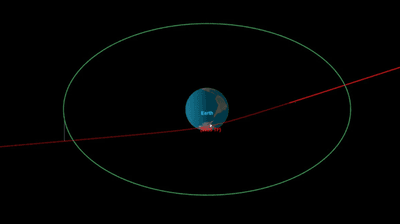


Astronomers have witnessed the second-closest asteroid fly-by ever measured. Or at least we think they have, with government shutdowns preventing NASA from releasing a statement. Luckily, the European Space Agency is still on the ball and caught it. Once again, however, we only noticed the visitor after it had already passed us.
Not long after midnight, Universal Time, on October 1, the still-to-be-discovered asteroid 2025 TF passed the Earth at a reported distance of 6,790 kilometers (4,330 miles), according to The Watchers. That doesn’t sound particularly close, until you realize the distance was measured from the center of the Earth, not the surface.
Even allowing for the planet’s slight flattening at the poles, that meant it passed about 420 km (260 miles) over Antarctica. That’s a typical height satellites use if we don’t want them to stay in orbit too long, risking space junk, and prefer atmospheric drag to bring them down. The International Space Station (ISS) maintains orbit around 408 km (253 miles) above us while satellites with longer-term ambitions, such as Hubble, fly a bit higher, at 550 km (340 miles). Original estimates placed asteroid 2025 TF even closer.
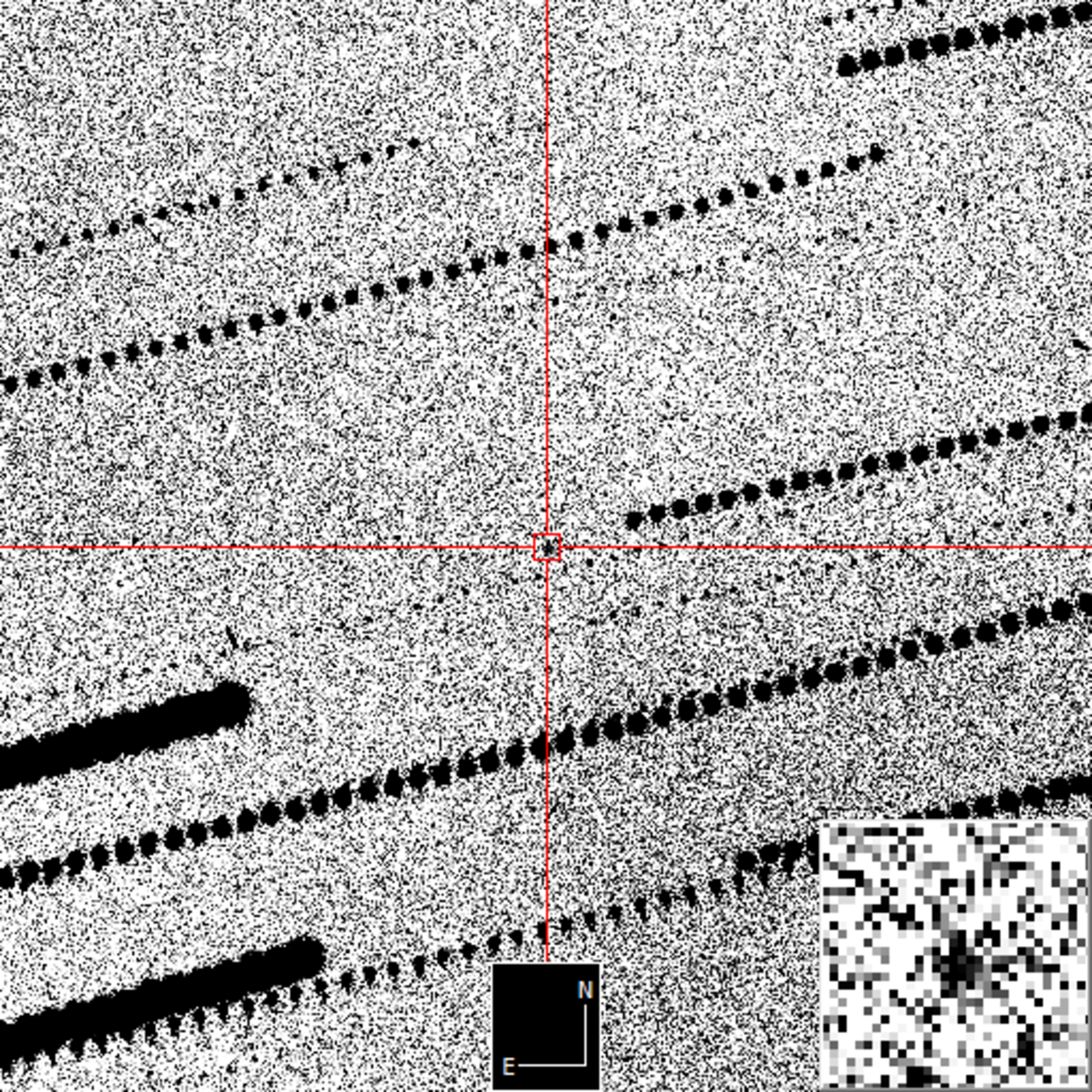
The asteroid, which is thought to be 1-3 meters (3 to 10 feet) across, was first spotted by the Catalina Sky Survey a few hours after it had passed Earth. ESA's Planetary Defense Office saw it shortly after its discovery. Objects of this size pose no significant threat; however, it would be good if we could spot them before they potentially hit, like the recent case of 2023 CX1, the first object tracked from discovery to finding meteorites.
Humanity has got a lot better at detecting close approaches – there have been more than 100 closer than the Moon just this year. The record for an observed close approach was 2020 VT4, which passed 6,746 km (4,190 miles) from the Earth’s center on November 13, 2020.
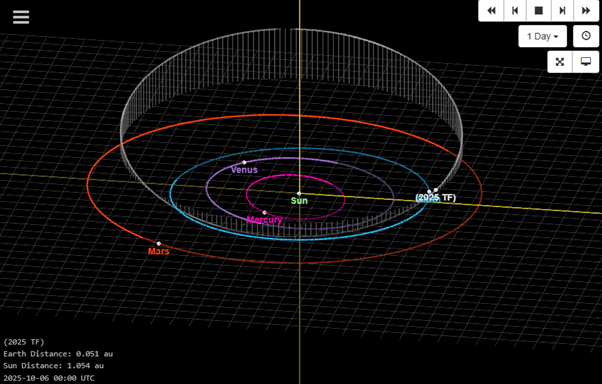
Nevertheless, warnings are not yet reliable. In the case of 2025 TF, the Bok Observatory at Kitt Peak noted the object almost five hours after closest approach and calculated its orbit backwards. NASA may not be issuing press releases while the government is shut down, but the Center for Near Earth Object Studies (CNEOS) at JPL estimates 2025 TF’s orbital period at 2.06 years (longer than Mars’), although with few observations to go on, this is quite approximate. 2025 TF’s orbit is far more eccentric than any of the planets, voyaging out past Mars to the main asteroid belt before swooping in, probably slightly closer to the Sun than Venus.
Had 2025 TF hit Earth, the lack of warning would have merely meant a lost opportunity for research. Setting aside the uninhabited nature of Antarctica, this object's size is bigger than 2024 CX 1 but still small by the standards of what we spot. Even though 2025 TF’s speed relative to Earth was 21 km/s, which is above average for close approaches (though far from the maximum), something that small is not very dangerous.
On the other hand, less than a month earlier, 2025 RM1 passed us at about a quarter of the distance to the Moon, and with an estimated size between 31 and 69 meters (100-215 feet), it’s a bit more intimidating. That’s similar in size to 2024 YR4, which is large enough that even a hit on the Moon is considered a threat. Once again, this visitor was only seen after it had passed, which is more disturbing for something large enough that we would definitely want to issue a warning.