Space and Physics
 PUBLISHED


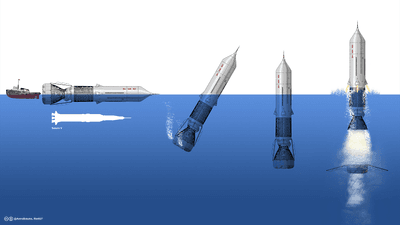


If you've watched the science fiction show For All Mankind, which explores an alternative history where the Soviet Union beat the US to the Moon and further fueled the space race, there's one particularly cool moment where a gigantic rocket is launched not from a traditional launchpad, but directly out of the ocean.
While you might dismiss the idea as entirely science fiction, it almost wasn't. The Sea Dragon, a super-heavy lift launch vehicle, was a real concept under consideration with NASA in the 1960s. If the design had come to fruition, it would have been the largest rocket ever built, at 150 meters (492 feet) tall and 23 meters (75 feet) in diameter.
In the 1960s (and all the way through to today), NASA was looking for cheaper ways to launch people and payloads into space. One idea was that instead of creating complicated, intricately-designed launch vehicles, it might be better to create something now termed a "big dumb booster".
"Current U.S. expendable launch vehicles (ELVs) were designed to meet stringent performance specifications. As a result, launch system designers gave relatively little priority to reducing launch costs. U.S," a review of the topic explains. "ELVs are derived from 1960s intercontinental ballistic missile designs that used high-performance engines and lightweight structures in order to minimize launch vehicle weight and maximize payload and range."
While these vehicles are efficient, they were expensive to manufacture, and expensive to keep at the right pressure ahead of launch. NASA began searching for more inexpensive alternatives based on the idea that it is cheaper to create and maintain bigger, simpler designs of rockets than complex, efficient designs (hence the term "big dumb rocket"). Sea Dragon was one of the proposals, led by American rocket engineer Robert Truax, which captured NASA's attention.
"The Sea Dragon concept has been developed assuming that space transportation economy will result if launch vehicles are used that are very large, simple, and reusable, even if payload-to-liftoff weight ratio is sacrificed in securing these characteristics," a 1963 NASA report explains.
As part of making the vehicle cheap(er), safe, and efficient, it needed to be launched from the ocean.
"The rocket was to be launched from a vertical floating attitude directly out of the water. After burnout, the stages were to be decelerated solely by normal atmospheric drag and water impact forces," NASA adds. "The recovered stages were to be towed back to the launch site for reuse. The seaborne operating concept was extended to include propulsion system development testing at sea using cruiser-weight, vehicle configuration tankage for full-scale work."
Though the concept was a cool one, and could have been a money-saver, budget cuts to NASA meant that the project never got off the ground, and we were robbed of the site of the world's largest rocket launching out of the water like a big metal, eventually space-faring dolphin.