Nature
 PUBLISHED


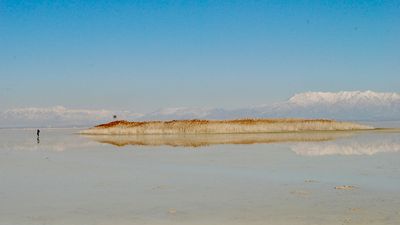


Something strange lurks beneath the biggest saltwater lake in the Western Hemisphere. Deep below the Great Salt Lake in Utah, scientists believe they may have found a giant underground pool of freshwater.
Suspicions of the subterranean freshwater reservoir first arose with the sudden appearance of strange reed-covered islands, each 50 to 100 meters (164 to 328 feet) in diameter, in the dried-out lakebed. One explanation for the mysterious mounds could be the upwelling of water from below, pushing up the lakebed and feeding the plant life with freshwater.
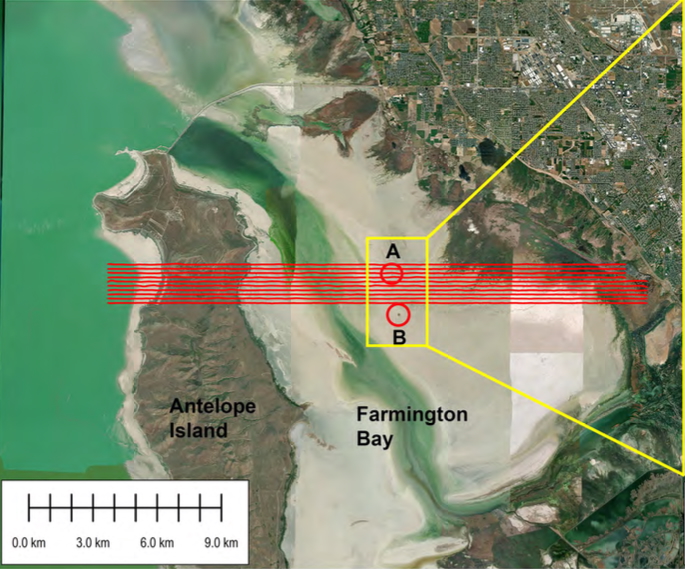
To pry into the mystery, scientists from the University of Utah recently flew over the Great Salt Lake in a helicopter and blasted it with electromagnetic pulses, allowing them to peer beyond the surface.
This revealed a relatively thin "basement" layer beneath Farmington Bay in the lake's southeast portion, below which lies a subsurface blob extending 3 to 4 kilometers (1.8 to 2.4 miles) down. Crucially, these deep drop-offs occur where the reed-covered mounds are found. Taken together, it seems very likely that this underground anomaly is a vast reservoir of freshwater.
“We were able to answer the question of how deep is this potential reservoir, and what is its spatial extent beneath the eastern lake margin. If you know how deep, you know how wide, you know the porous space, you can calculate the potential freshwater volume,” Michael Zhdanov, a distinguished professor of geology & geophysics and director of the Consortium for Electromagnetic Modeling and Inversion (CEMI), said in a statement.
The presence of freshwater is pretty surprising since the Great Salt Lake, as its name suggests, is incredibly saline, possessing waters that are up to eight times saltier than the ocean. Equally unexpected, the geologists believe the freshwater is entering the underground pool toward the lake's interior rather than its peripheral edges, which is typically the case in similar settings.
“The unexpected part of this wasn't the salt lens that we see near the surface across the playa. It's that the freshwater underneath it extends so far in towards the interior of the lake and possibly under the entire lake. We don't know,” Bill Johnson, a co-author of the study and hydrologist and the University of Utah, said on a recent appearance on KPCW’s Cool Science Radio show.
“What we would normally expect as hydrologists is that the brine would occupy the entire volume underneath that lake. It's denser than the freshwater. You'd expect the freshwater from the mountains to come in somewhere at the periphery. But we find it's coming in way towards the interior. And there's what appears to be a deep volume of this freshwater coming in underneath that saline lens,” he added.
An abundance of freshwater water here would be somewhat of a blessing. The Great Salt Lake is struggling with a lengthy drought and large swathes of Farmington Bay are becoming totally dried out. In turn, the desiccated lakebed is turning into toxic dust laced with heavy metals that threaten to blow into the local area.
If scientists can find a way to harness the newfound freshwater, it could help address the lake's growing dust pollution problem. However, further research and geomagnetic mapping will be needed to determine whether the subterranean supply can be safely and sustainably tapped.
“There are beneficial effects of this groundwater that we need to understand before we go extracting more of it. [...] A first-order objective is to understand whether we could use this freshwater to wet dust hotspots and douse them in a meaningful way without perturbing the freshwater system too much,” Johnson continued. “To me, that's a primary objective because it's very practical and it's unlikely we'll be able to fill Farmington Bay and other parts of the playa high enough to avoid some dust spots appearing at the higher elevations. This would be a great way to get at that.”
The study is published in the journal Scientific Reports.