Space and Physics
 PUBLISHED





When the FIFA World Cup kicks off next month, millions of people will rediscover an interest in football dormant for four years. Other outlets might take the chance to refresh their knowledge of the offside rule, but at IFLScience our interest is in another aspect of the sport: how some players bamboozle defenders and goalkeepers by sending the ball on curving paths.
To begin, a little terminology background. FIFA stands for Fédération Internationale de Football Association, or International Association Football Federation. The term "soccer" derives from an abbreviation of "association football" and while that term is most popular in places where other football codes are more predominant, such as North America and Australia, it actually originated in England as a way of differentiating the sport from rugby football – now known simply as rugby. Since most of the world ended up adopting "football" as the shortened name for association football, that's what we'll be using in this article.
In a 1997 international match, Brazilian Roberto Carlos succeeded in getting a free kick to bend so much the French goalkeeper didn’t bother to move, assuming it would comfortably miss, only to see it go in. Commentators referred to the shot as “the goal that defied physics” but 13 years later, French physicists – having finally got over their disappointment at the outcome – published a peer-reviewed paper on how it was done. In between, a similar talent lay at the heart of the celebrated movie Bend It Like Beckham.
There are two main physical effects that are harnessed in shots like these, but physicists don’t entirely agree on their relative importance.
The Magnus Effect
The better-known contributor to sending a ball on a looping path is the Magnus Effect, which balls experience when they spin while also undergoing directional motion. The Magnus Force only occurs because no surface is perfectly smooth; footballs certainly aren’t.
The roughness of the ball means that when it spins it drags air along with it. If you twirl a ball while otherwise keeping it still, this drag on the surrounding air creates a small breeze, but the ball experiences no net force. However, a ball that is kicked in just the right way will move away from the kicker’s foot, while also starting to spin.
From the ball’s perspective, the air around it moves in two distinct ways. Both Carlos and Parminder Nagra's character Jess make their balls spin anti-clockwise, as seen from above, while also moving forwards. The forward motion moves the ball through the air, but from the ball’s perspective that’s air rushing past it in the direction it came from. On the ball’s left-hand side the spin drags air along with it, adding to the passage of air from the forward movement. On the ball’s right, however, the dragged air is in the opposite direction to the airflow created by the ball’s net direction.
As a result, the air is moving faster on the left-hand side of the ball than the right. Faster moving air exerts less sideways pressure. Consequently, the ball experiences an area of fairly normal pressure on the right, and low pressure on the left. The net force to the ball’s left makes it curve, sending a shot that appears to be going wide into the goal.
An astonishing demonstration of how powerful the Magnus Force can be is seen in videos where spinning balls are dropped from great height, causing them to veer dramatically. The importance of roughness and weight can be seen by comparing the paths taken by the balls used in different sports.
In its own wake
The Magnus Effect is certainly real – even Newton noted its effect on tennis balls centuries before Magnus studied it enough to have it named after him - and gets the most attention. However, when Bend it Like Beckham made the curve a cultural phenomenon far beyond sports fans, Professor Lou Bloomfield of the University of Virginia told Inside Science News the wake deflection force may matter more.
"Most moving balls have turbulent wakes behind them," Bloomfield said. "As it spins, a ball draws the air with it and deflects the wake to one side." On the basis that every action has an equal and opposite reaction, the force the ball applies to the air is balanced by the air’s pressure on the ball.
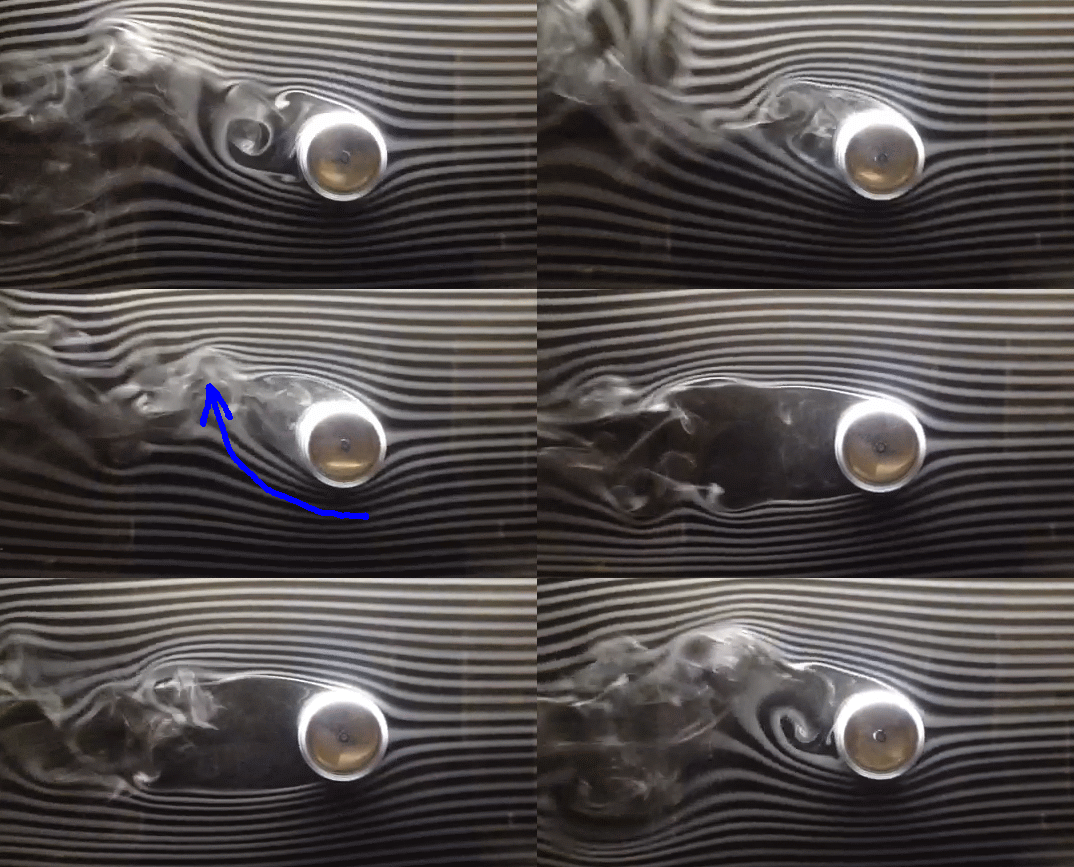
The Magnus Effect and the wake deflection force push the ball in the same direction, reinforcing each other to create a curving path, and some physicists consider them aspects of the same force, while Bloomfield clearly disagrees. The fact that the two combine means that even if you consider them as separate, it’s hard to determine how much of the curve each provides.
Other sports
The use of these effects in the round-ball form of football is rare enough to get noticed when it happens, but the capacity to use spin to bend balls’ paths is applied more frequently in many other ball sports. Sometimes this involves similar sideways movement, such as a pitcher using curveballs to confuse batters who expect a straight pitch.
A more widespread, but less obvious, application, is to make a ball either drop more sharply, or travel further, using top or backspin. These occur when the axis on which the ball spins is parallel to the ground, rather than (approximately) perpendicular as in Carlos’ kick and other famous shots on goal.
Topspin has the ball spinning so that the top is turning in the same direction as it is moving, while the underside is rotating the other way. This creates a lower pressure under the ball than above it, forcing it downwards faster than gravity would do on its own. Tennis and volleyball players can use this to make a fast-moving ball drop sharply, landing inside the court. Backspin does the opposite, making the ball fly further.
Golf balls have their dimples so they will drag more air with them as they spin. This helps a ball with plenty of backspin – as clubs are designed to apply – fly much further. The dimples can be a two-edged sword when it comes to sideways movement, making hooks or slices bend farther than they would otherwise.
Although spin bowlers use the same principles to make their deliveries deceive batters in cricket, swing bowlers rely on somewhat different physics principles, which are a matter for another time.