Humans
 PUBLISHED
 1
1


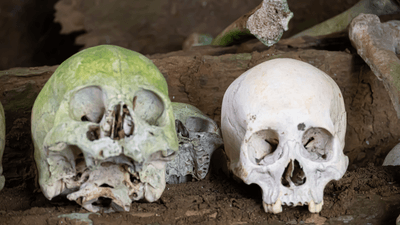


Mummification can happen in all sorts of ways. It can be slow and steady, or as rapid as a matter of days. It can result in pleasantly scented mummies, bound mummies, potentially hazardous mummies and, in very rare cases: green mummies.
Yes, this is The curious case of the green-colored body, an investigation into a most unusual specimen that’s been preserved in a remarkably vibrant shade of green. They are the remains of a teenager who died between 200 and 400 years ago in Italy, and in case you’re wondering, no – finding green mummies isn’t commonplace.
The mummified remains were excavated from a burial site in Bologna, Italy, and are almost complete except for the feet. They comprise a human skeleton with some soft tissues still attached, most of which exhibit this curiously hued green staining (you can see a picture of the remains here).
To get to the bottom of what was going on, a team of scientists took on a multidisciplinary approach to closely inspect the remains. They employed the help of everyone from anthropologists to geneticists, radiologists, computer scientists, and physicists to get an idea of what was going on.
Their combined toolbox included such toys as Fourier Transform Infrared (FTIR) spectroscopy, Raman spectroscopy, and Scanning Electron Microscopy coupled with Energy Dispersive X-ray Spectroscopy (SEM-EDS). These techniques meant they could examine the stained and unstained portions of the remains to compare their organic and inorganic components.
An important detail in this story is that the teenager had been laid to rest inside a copper-alloy cist, which is essentially a small coffin-like box. Inside that box, the body underwent putrefaction, liquefaction, skeletonization, and partial mummification.
These processes released acids that slowly corroded the cist, releasing copper products that essentially mixed with the remains, staining the bones and soft tissues. The bones were stained as copper ions replace calcium, and the soft tissues were stained because they got coated in the same green-tinted stuff (verdigris) you see developing on old statues.
The finding has implications for our understanding of how heavy metals impact the preservation process. It also provides a fresh perspective when studying funerary practices of the past – after all, the makeup of coffins (or is it caskets?) has changed considerably over the years.
Tutankhamun had an outer gilded coffin, a lead-lined coffin was used to contain the radioactivity of Marie Curie’s body, and the case of “the woman in the iron coffin” is a reminder of a brief trend that ended in the mid-1800s. As this beautiful green mummy just goes to show, the decisions we make for the afterlife can have all kinds of effects on what we leave behind.
For those who’d rather leave no trace, have you heard about human composting?
The study is published in the Journal Of Cultural Heritage.