Culture and Society
 PUBLISHED
 1
1




Ever made a bold claim only to be immediately proven wrong? Yeah, happens to the best of us. Michael Fish and the hurricane. The “unsinkable” Titanic. Then there was that time one of America’s biggest newspapers predicted it would take one to 10 million years to make a flying machine, 69 days before we managed it.
Cast your mind back to the year 1903. If you weren’t alive yet (good, I won’t send the Zombie Police to your home), it was a time when humans had yet to take to the skies, but that wasn’t for lack of trying.
Our species’ dreams of flying date back to 400 BCE, when kites inspired humans in China that perhaps one day we, too, could soar through the skies. Various iterations of attempted flying machines emerged over the centuries that followed, and though they were largely unsuccessful, it taught us a lot about the mechanics of flying.
"The ridiculous fiasco"
In 1903, an aviation pioneer called Samuel P Langley attempted to launch his own kind of airplane. It was a failed attempt and, as we press love to do, the newspapers were quick to swoop in and spread word of Langley’s shortcomings.
“The ridiculous fiasco which attended the attempt at aerial navigation in the Langley flying machine was not unexpected, unless possibly by the distinguished Secretary of the Smithsonian Institution, who devised it, and his assistants,” reads the editorial published on October 9, 1903.
The author makes the fine point that flying really ought not to be in our wheelhouse, considering flight only evolved in birds across innumerable generations. Why, they argue, should scientists expect to achieve the same results with less suitable materials over a much shorter period of time?
“Hence, if it requires, say, a thousand years to fit for easy flight a bird which started with rudimentary wings, or ten thousand for one which started with no wings at all and had to sprout them ab initio, it might be assumed that the flying machine which will really fly might be evolved by the combined and continuous efforts of mathematicians and mechanicians in from one million to ten million years-provided, of course, we can meanwhile eliminate such little drawbacks and embarrassments as the existing relation between weight and strength in inorganic materials,” they wrote.
The Wright Flyer
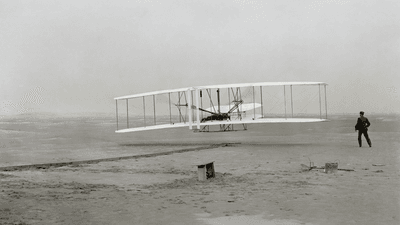
All good points very loquaciously made, until you learn what happens on December 17, just two months later. Yes, that was the day the Wright Flyer, also known as the Kitty Hawk Flyer, made the first-ever sustained flight by a crewed aircraft that was heavier than air.
Flown by brothers and creators Orville and Wilbur Wright, it managed four flights reaching a maximum height of 260 meters (852 feet) before experiencing a mild crash landing followed by a catastrophic tumble as the wind blew it over. Not a perfect execution, but top marks for their timing.
Given they remain a media giant over a century later, it's safe to say The New York Times bounced back just fine. And thank goodness! After all, where would we be without Wordle?