Humans
 PUBLISHED
 2
2


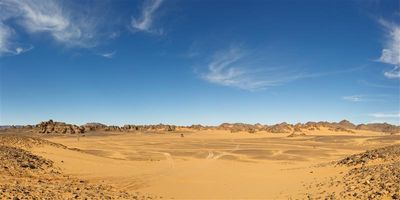


Egypt is the home to the oldest mummies in Africa, right? That at least is the assumption most of us likely have – but there is evidence challenging this. Deep in the desert mountains of southwest Libya, researchers uncovered the mummified remains of a long-dead child, known as the Tashwinat mummy, that predates Egyptian mummies by over a thousand years. So what do we know about this ancient infant mummy?
In the winter of 1958, so the story goes, the archaeologist Fabrizio Mori was exploring a natural cave shelter known as Uan Muhuggiag, an archaeological site that was occupied by pastoralists (cattle farmers) at different times. During his examination, Mori apparently noticed signs of this ancient habitation in the form of rock art depicting people, animals, and cattle, as well as graffiti, from different periods. But as he started to dig in the cave’s soft sand floor, he also found a strange bundle buried near the surface.
This bundle, made of goat or antelope skin, was covering the desiccated body of a small child who had been wrapped in a layer of leaves. The child had undergone some form of mummification process. The child’s organs had been removed post-mortem through incisions in the abdomen and thorax, a process known as evisceration, and replaced with herbs (probably to help preserve the body).
The body was positioned in the fetal position and there was an ostrich eggshell necklace found around its neck.
Analysis of the body suggests the child was around 3 years old when they died. Additional analysis shows the child possessed a dark skin complexion.
Dated using radiocarbon dating, the mummified child is thought to be between 5,400 to 5,600 years old.
When the child was alive, the Sahara would have looked very different from how it does today. Far from being an arid desert, the people who visited Uan Muhuggiag would have inhabited a far greener landscape. This time, sometimes referred to as the “African humid period”, saw the Sahara covered in grasses, trees, and lakes, which would have helped sustain the cattle farmers who lived around the site.
Further evidence that this part of North Africa was far wetter than it is today is apparent from local cave art that depicts elephants, giraffes, and crocodiles, while fish bones and ancient fishing equipment have been found in other sites across the Sahara.
So how does this ancient mummy relate to Egyptian versions? At the moment it is unknown whether this earlier mummification practice influenced the other, but it does open up the possibility that mummification in Africa has a much deeper and more complex history than previously thought.