Space and Physics
 PUBLISHED
 1
1



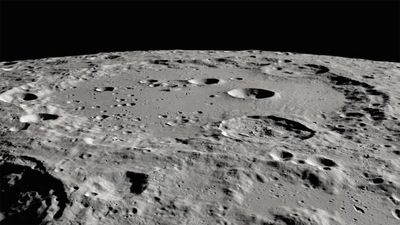


The Moon used to be hotter, but it has cooled down with time. This has a major consequence: The Moon is shrinking. It won’t collapse on itself like a soufflé – it is still made of rocks after all. But just like a grape dehydrating into a raisin, the shrinking moon is getting more wrinkles. And with those, there are moonquakes and landslides.
New research investigated the effect that recorded moonquakes might have on the surface of the Moon, in particular around the lunar South Pole. That is an area of great interest for future human and robotic exploration. The work found that some surface slopes in the area are particularly vulnerable to coming apart from the shaking.
“You can think of the moon’s surface as being dry, grounded gravel and dust. Over billions of years, the surface has been hit by asteroids and comets, with the resulting angular fragments constantly getting ejected from the impacts,” co-author Professor Nicholas Schmerr, from the University of Maryland, said in a statement. “As a result, the reworked surface material can be micron-sized to boulder-sized, but all very loosely consolidated. Loose sediments make it very possible for shaking and landslides to occur.”

Shallow moonquakes, as the name suggests, are not very deep, coming from 50–220 kilometers (30 to 135 miles) below the surface. They are not very powerful either. The strongest on record was at most a magnitude 5.7, originating in the Southern Polar region. While weaker than Earth’s counterparts, moonquakes last for hours, making them a concern that should not be underestimated.
“Our modeling suggests that shallow moonquakes capable of producing strong ground shaking in the south polar region are possible from slip events on existing faults or the formation of new thrust faults,” said the study’s lead author Thomas R. Watters, a senior scientist emeritus in the National Air and Space Museum’s Center for Earth and Planetary Studies.
“The global distribution of young thrust faults, their potential to be active and the potential to form new thrust faults from ongoing global contraction should be considered when planning the location and stability of permanent outposts on the moon.”
Researchers continue to work to understand the areas of the Moon that might have significant seismic risk. These areas will have to be avoided for future permanent settlements – but even short sojourns might be at risk if they get too close to the shaky slopes.
“As we get closer to the crewed Artemis mission’s launch date, it’s important to keep our astronauts, our equipment and infrastructure as safe as possible,” Schmerr said. “This work is helping us prepare for what awaits us on the moon—whether that’s engineering structures that can better withstand lunar seismic activity or protecting people from really dangerous zones.”
The paper is published in The Planetary Science Journal.