Nature
 PUBLISHED



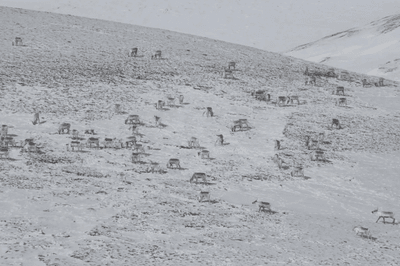


The longest land migration of any animal features a round trip of up to 1,200 kilometers (745 miles) through the wilderness of northern Alaska and Canada. That migration is undertaken by caribou, the roaming reindeer that move with the seasons from their southern ranges in the forests and mountains towards their calving grounds in the Arctic.
A 2019 study published in Scientific Reports found that herds of caribou (Rangifer tarandus) exhibit the longest terrestrial migrations on the planet, at least in terms of straight-line, round-trip distance.
The researchers acknowledge that other species may have longer migrations, but caribou are the farthest among species where individuals have been tracked throughout their entire migration. So, as it stands, the evidence points firmly to the caribou, particularly the Bathurst Herd and Porcupine Herd.
The Guinness World Records goes further and claims the Porcupine Herd can travel 4,800 kilometers (2,982 miles) per year. However, it's unclear where that figure comes from and whether it's reliable.
Where Do Caribou Migrate?
The basic pattern goes like this: As spring approaches and the ice begins to thaw, herds of caribou head northward toward the Arctic Circle in Alaska and Canada's Yukon territory. The Arctic tundra, newly flush with freshly sprouted vegetation, offers rich feeding grounds, plus there are fewer predators and bothersome biting insects compared with the warmer lower latitudes. In this relative safety, pregnant females give birth and raise their young through the brief summer months.
When temperatures drop toward the end of autumn, the caribou and their calves begin the long trek to more southern latitudes, where food remains abundant through the winter.
This is a very simplified illustration. Even in North America, caribou aren't a uniform population, and there are several distinct ecotypes, each with migration patterns shaped by its environment, whether tundra, boreal forest, or mountains.
It's the tundra-dwelling "barren ground" caribou that are the great migrants. Meanwhile, their counterparts in boreal forests tend to live fairly sedentary lives, as this environment is better at providing them with food and safety all year round.
Some Animals Travel Even Further
Interestingly, the same study found that while caribou hold the record for the longest migration, it's grey wolves that cover the most ground over the course of a year.
The researchers note that one male grey wolf in southwest Mongolia traveled over 7,247 kilometers (4,503 miles) in just one year, but it did so in a near-continuous marathon, likely while hunting for prey or searching for mates. That distance is roughly the same as walking from Washington, DC, to Los Angeles and back again in a year.
Likewise, certain wolves in Alaska and the Yukon Territory can travel up to 5,630 kilometers (3,498 miles) annually. Once again, these valiant journeys are typically made by packs that are perpetually on the move while tracking moose or, fittingly, caribou.
None of these land-dwellers can hold a candle to birds, however. Bar-tailed godwits (that’s a species of shorebird, not an insult) are known to complete the longest non-stop migration by flying. In 2022, researchers recorded one bird flying 13,560 kilometers (8,435 miles) between Alaska and Tasmania in just 11 days.
It’s an incredible feat, but it comes at a terrible cost: to remain airborne for over one week, the birds must effectively eat their own liver.