Space and Physics
 PUBLISHED


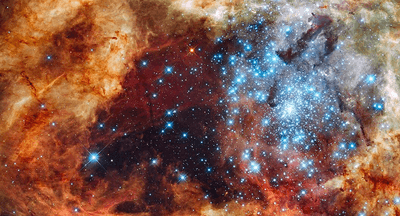


A cluster of stars known as LAP1-B, seen around 800 million years after the universe was formed, is the first we have seen consistent with being composed of the first stars, a new paper claims. That is, these would be stars whose initial ingredients were entirely forged in the Big Bang, rather than by an even older set of stars. Despite the difficulties in confirming such a claim about a system so far away, the authors argue there are three tests we should apply in seeking a system made of original stars, and LAP1-B meets all of them.
When Joni Mitchell sang, “We are stardust”, her words didn’t just apply to a generation, but the whole Solar System, and probably all the others in our galaxy as well. Nearby stars are formed from the remnants of those that lived and died before, producing elements heavier than helium in the process. Moreover, this has happened at least twice.
Counterintuitively, the Sun is known as a Population I star, and its predecessors that formed the iron, carbon, and oxygen that make us up are called Population II stars. Even these, however, are not believed to be original, having been composed of the remains of the fabled Population III (Pop III) stars, which represent something of a holy grail for astronomers. LAP1-B might be where we finally find them.
Pop III stars began with the hydrogen and helium direct from the Big Bang, and made other elements in their lives and deaths. Heavier elements prevent stars becoming too large, but without them in the raw material, most Pop III stars were giants.
Since the more massive the star, the faster it burns and the shorter it lives, any surviving Pop III star in the local universe would be an anomaly, although there are sometimes hints of finding one. To find a Pop III collection, we need to look so far back in time even the largest stars had little opportunity to flame out.
This has always been one of the JWST’s prime jobs, but it can’t do it without help. Such stars would be so distant that the only way we could see them, at least clearly enough to identify their Pop III status, is if an intervening gravitational lens focused their light.
Two years ago a collection of stars called LAP1 (short for Lensed and Pristine 1) was announced, based on JWST images and described as “approaching Population III stars.” But were we approaching them, or actually there?
A study still undergoing peer review revealed the component LAP1-B as an example of a truly ancient cluster that has been powerfully lensed, and describes it as: “The most chemically primitive star-forming galaxy yet identified.” That’s the type of environment in which we would expect to find Pop III stars, but just because LAP1-B could contain Pop III stars, doesn’t mean it does.
The centers of galaxies evolve faster than their outskirts, so collections of Pop III stars should exist in the haloes of galaxies closer, and therefore easier to see, than those with Pop III stars at their core.
The University of Toledo’s Dr Eli Visbal and Ryan Hazlett, and Professor Greg Bryan of Columbia University argue in their newly published paper that galaxies preserving Pop III stars would have three features we might be able to detect:
- Haloes with almost no metals and temperatures of 1,000 to 10,000 degrees,
- Stars with masses 10 to 1,000 times the Sun’s, and
- Clusters of stars containing a few thousand solar masses in total.
LAP1-B meets all of these tests, they argue. As the authors note, “There have been a number of previous claims for the detection of classical Pop III galaxies,” but these have all involved far more massive clusters, inconsistent with the third predicted feature.
LAP1-B is not entirely lacking in the heavier elements astronomers call metals. It has some oxygen, but the authors calculate the amount we see is about what we would expect if among a few tens of stars one had gone supernova and dispersed its products through the cluster.
Alternatively, if the stars in LAP1-B are rapidly spinning, some of the oxygen they have made would come off them. Around seven stars of 30 solar masses, or three of 150 solar masses, would be sufficient to provide the oxygen detected. If so, LAP1-B would be entirely pristine, composed only of first generation stars.
The study is published open access in The Astrophysical Journal Letters.
[H/T: Phys.org]