Nature
 PUBLISHED
 1
1


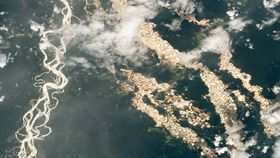


High above the Peruvian Amazon, the forests beam with gold. While the glittering pits might look pretty from low-Earth orbit, the image actually highlights a worrying problem back home on planet Earth.
An astronaut on board the International Space Station (ISS) took this photograph of gold prospecting pits while drifting above eastern Peru on Christmas Eve 2020. Perfectly hit by the Sun’s beams, the gold-rich pits beam back with a radiant reflection.
As explained by NASA Earth Observatory, the prospecting pits consist of hundreds of tightly packed water-filled basins surrounded by de-vegetated areas of mud. The worm-like interwoven channels on the left side of the image are the Inambari River and the Tambopata National Reserve, which is legally protected from mining, is also visible just below the clouds in the top right of the photo. Although the photograph has been lightly edited to improve contrast, it was simply taken with a commercially available Nikon D5 digital camera.

Gold mining is big business in Peru, the sixth-largest producer of the precious metal in the world. Unfortunately, some of this extraction is fuelled by illegal mining, involving destructive processes that devastate the local environment and Amazonian communities. In recent years, there have been ongoing troubles in Peru’s Madre de Dios where a modern-day Goldrush has seen makeshift cities pop up and recklessly exploit the environment for metals. Along with extensive deforestation — an area roughly the size of New York City, by some counts — it’s also introduced floods of polluted water in the surrounding ecosystem.
One of the main concerns is mercury and its highly toxic cousin methylmercury. Gold miners often use mercury to separate their gold ore from soil and sediments, often without adequate safety precautions. The mercury, itself a potent neurotoxin, seeps into ponds and can then be converted into the super-toxic chemical methylmercury through microbial processes.
This is becoming a growing problem in Peru and other parts of South America. On top of dealing with mercury poisoning and the environmental impact of illegal gold mining, Amazonian communities have also been subject to violence from gold mining encroaching on their land. In the early 1990s, for example, a group of miners entered the village of Haximú in Brazil and massacred 16 Yanomami people, including a baby, eventually resulting in five miners being found guilty of genocide. More recently, two Yanomami people were reportedly killed after a confrontation with gold miners in northern Brazil.
Last year, the Yanomami Indigenous people launched a global campaign to kick out thousands of illegal gold miners from their land in the Brazilian Amazon. Their campaign is gaining momentum, but the problem remains unresolved for now.