Space and Physics
 PUBLISHED


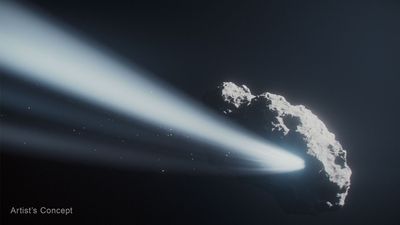


A comet was seen doing something never-before-witnessed: it changed its spin, slowing down and reversing its direction of rotation. This observation was something quite unexpected, and it has to do with the size of the comet and what happened after its perihelion, the closest passage to the Sun.
The comet in question is 41P/Tuttle-Giacobini-Kresák, and the perihelion happened in April 2017. Observations from March of that year by the Discovery Channel Telescope at Lowell Observatory in Arizona were compared with the observations by NASA’s Neil Gehrels Swift Observatory in May 2017. In May, the comet was rotating on its axis three times more slowly, going around its axis once every 46 to 60 hours.
In a new analysis based on the Hubble Space Telescope's December 2017 observations, the comet seemed to have sped up again by the end of the year, going around in about 14 hours. Outgassing from the surface must have first slowed down, then stopped, and eventually reversed the spin of this object.
“Jets of gas streaming off the surface can act like small thrusters,” author of the new study, David Jewitt of the University of California, Los Angeles, said in a statement. “If those jets are unevenly distributed, they can dramatically change how a comet, especially a small one, rotates.”
“It’s like pushing a merry-go-round,” added Jewitt. “If it’s turning in one direction, and then you push against that, you can slow it and reverse it.”
The comet is small, just a kilometer in size, which allowed for this effect to take place so easily. The comet used to be a lot further away from the Sun. Then Jupiter’s gravity pushed it into a much closer orbit. Now it goes around the Sun in just 5.4 years. The comet also used to be a lot more active. The 2017 perihelion has one-tenth of the activity of the 2001 perihelion. This suggests major changes in this object.
The fate of this comet is uncertain. The models suggest that it might continue speeding up with future perihelions, leading to the comet eventually breaking apart.
The new analysis is published in The Astronomical Journal.