Space and Physics
 PUBLISHED


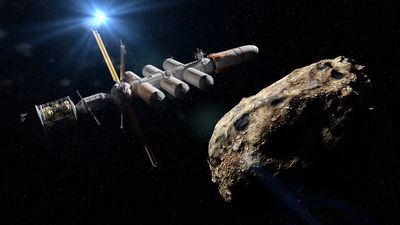


Mining on Earth is a very complicated issue. So much of what we need in society comes from the processing of ores, and yet there are major environmental and social drawbacks to that kind of extraction. It has been suggested that in the future – even the near future – the solution could be mining in space, particularly certain asteroids that might be rich in elements or minerals that are rare on Earth.
The reality of actual asteroid mining is far from simple; but the idea, which has proliferated in fiction, has taken some tentative steps forward over the last decade or so. With the upcoming release of season five of For All Mankind on Apple TV – which focuses, among other things, on asteroid mining – we spoke to the series' executive producers to talk about the choice of such a topic and what we know about it in reality.
For All Mankind is an alternative history TV show whose premise sees the Soviet Union beating the United States to the Moon. The consequence of that is an escalation of the Cold War in space, leading humanity down a whole different path where human presence on the Moon and far beyond is a given, unlike the world of today.
In season four, the discovery of the "Goldilocks" asteroid, possessing 70,000 metric tons of iridium, became an important plot point. In the show, it is worth 20 trillion dollars, and the race is on to place it in a stable orbit around Earth for extraction. People working on Mars and with a stake in its future, though, have another idea.
“I think the promise for us of asteroid mining in the show and the world of the show is that there are these untold resources, these in-demand minerals that are quite rare on Earth, if at all on Earth, and having access to them,” executive producer Matt Wolpert told IFLScience.
“It became the new kind of resource that everyone is fighting over, like fossil fuels have been for the last 100 years. So it felt like a great generator of conflict in our story. It gave [the people on Mars] a chip to play in the game of world politics, like they now have control over a resource that everybody else wants.”
Season four takes place in 2003, and season five will pick up the action in 2012. Everything that is happening is far beyond our current capabilities when it comes to deep-space human exploration. Let’s start from the very beginning. Finding these objects is far more complex than one might think.
It's definitely intriguing to us this season, where we are leaning into it even more, that they go beyond Mars this year for the first time ever.
Ben Nedivi
There are a lot of asteroids out there for sure, but we should not picture them as giant gold nuggets (or platinum nuggets) floating through space. Research from 2015 puts a very conservative value on the number of ore-bearing asteroids near the Earth: just 10. The most optimistic value has the number at about 3,700, about 10 percent of the total number of the known near-Earth asteroid population.
AstroForge, which would like to mine asteroids, actually places the value at about half of that. The company launched a deep space mission to near-Earth asteroid 2022 OB5 last year to study it up close. Unfortunately, they lost contact with the spacecraft soon after launch. If successful, it would have been the first private company to go beyond the Earth-Moon system.
The presence of metals on these objects is obviously the crucial aspect, but observations from Earth are not sufficient to be certain of how much metal is on these objects, if it would be easy to extract, and if it is in general worthwhile to actually mine it. Going into space is not as costly as a decade ago, but it is still pretty expensive. Added to that are the technological challenges of actually mining asteroids in an environment very much unlike Earth.
There’s also the fact that asteroid mining sits in a complicated gray area in international law. The US unilaterally allows for the commercial extraction of material from celestial bodies, based on its interpretation of the Outer Space Treaty. Other countries have followed suit, but nobody has mined an asteroid yet, so we have not seen an interest in actual regulation on that front. It seems that fiction is way ahead of facts when it comes to asteroid mining.
The other big thread hinted at for this season is the possibility of alien life on the icy moons of Jupiter and Saturn. Well, NASA and the European Space Agency (ESA) have two missions – Europa Clipper and JUICE – getting to Jupiter in just a few years, and ESA is even planning a daring mission to the surface of Saturn’s Enceladus. Maybe on that front, fiction is only marginally ahead.
“It's definitely intriguing to us this season, where we are leaning into it even more, that they go beyond Mars this year for the first time ever. They're sending missions to moons of Saturn, the moons of Jupiter,” executive producer Ben Nedivi told IFLScience.
“I think the idea that space exploration has reached the point where Mars is basically a home for people, and now we're going even beyond, is kind of proof of how our alternate history has succeeded in a wild way, where the fact that we're able to even consider going to these places is fascinating.”
For All Mankind's new season starts on March 27.