Nature
 PUBLISHED


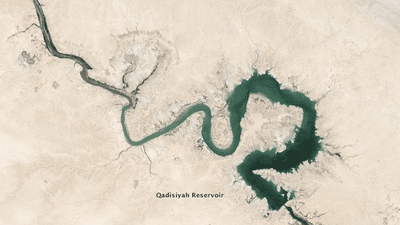


According to the Book of Revelation, the only apocalyptic book contained within the New Testament in the Christian Bible, the final battle between good and evil will be preceded by a number of key events, one of which would be the drying up of the Euphrates River. Unfortunately, according to research from scientists, including those working at NASA's Gravity Recovery and Climate Experiment (GRACE), the ancient river does appear to be drying up, though it is more of a symptom of a global crisis than a signal of an upcoming apocalypse.
The Euphrates River has historically been pretty important to humanity. Originating in Turkey, the river runs right through modern Syria and Iraq, before reaching the Persian Gulf. Ancient Mesopotamia, thought to be the first "cradle of civilization" in the world, relied on the river, and the Tigris, in order to farm and thrive. It is no wonder that this important river, which so many ancient people relied on for survival, as well as trade, made several appearances within the Bible, being associated with the Garden of Eden as well as the Book of Revelation.
In Revelation 16, it gets a dramatic role in the final days of Earth. Angels begin to pour out seven bowls or jars of God's anger onto the Earth, some of the last events preceding the final battle between Good and its frenemy Evil. The sixth jar is where the Euphrates gets a callback.
"The sixth angel poured out his jar of God’s anger onto the great Euphrates River. The water dried up. In this way, the kings of the countries of the east could cross over," the passage reads. "Then I saw three demons that looked like frogs. They came out of the mouths of the dragon and the second wild animal and the false preacher. These are demons that do powerful works. These demons go to all the kings of all the earth. They bring them together for the war of the great day of the All-powerful God."
This passage has made a surprising appearance in news articles over the last few days, due to the fact that the Euphrates does appear to be drying up. This isn't exactly new information though, with NASA's GRACE finding that the river has lost a significant amount of water in recent decades.
"The research team observed the Tigris and Euphrates river basins – including parts of Turkey, Syria, Iraq, and Iran – and found that 117 million acre feet (144 cubic kilometers) of fresh water was lost from 2003 to 2009," NASA explained in a statement in 2013. "That amount is roughly equivalent to the volume of the Dead Sea. About 60 percent of the loss was attributed to the pumping of groundwater from underground reservoirs."
The problem in the intervening years has not gotten any better, compounded by increased temperatures in Syria of around 1 °C over the last 100 years, and a decrease in rainfall of around 18 millimeters a month over the same timeframe. In 2021, a report produced by the Iraqi Ministry of Water Resources found that the river could run dry as soon as 2040 thanks to a combination of the climate crisis and poor water management.
Whilst that is certainly "not good", with people in the region relying on the river to live, it is far from apocalyptic in the modern world. But back when the Book of Revelation was written, the river running dry would certainly feel like it. The Euphrates marked the edge of the Roman Empire, separating it from Parthian power in the Near East, and the passage likely reflects fears of real invasion and war.
As well as this, modern people don't really interpret apocalyptic literature as it was initially intended, as we are not used to this once prolific genre of writing.
"Not so for people in the ancient world who would have been more accustomed to the complex nature of apocalyptic literature. The very fact that an apocalypse was a common type of literature meant that if followed certain conventions of style, and people knew more what to expect from it," L. Michael White, Professor of Classics and Christian Origins at the University of Texas at Austin, wrote for PBS.
"Apocalyptic literature was almost always a kind of literature for 'insiders,' that is to say, it was written for people who already knew something of the situation and of the symbols that were used to portray it. So, for the original audience of the Revelation of John, all these strange scenes would have been immediately intelligible."
If that is a little too abstract for you, we should also mention that none of the other bowls of God's wrath appear to have been poured out on the Earth. The same part describes seas turning to blood and all the animals within it dying, as well as humans being burned up by the Sun, hail the weight of a large child raining down upon the Earth, and islands and mountains disappearing entirely. In short, the Euphrates River drying up is not great for the world, but is certainly not a predicted event leading to Armageddon.