Nature
 PUBLISHED


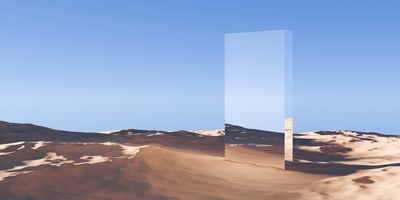


Later this year, a self-powered steel monolith “black box” designed to record “every step” our species takes towards, or away from, a climate catastrophe will be installed in Tasmania, Australia.
Five years ago, the Rouser Lab, an Australian non-profit organization, announced its intention to create Earth's Black Box. Most people are likely familiar with the types of black boxes used in the aviation industry. These devices are installed on planes to gather critical flight data and cockpit audio to help investigators piece together events should any accidents occur.
Taking inspiration from this, the Australian organization decided to create its own version for climate change.
“Inspired by an aeroplane’s indestructible flight recorder, Earth’s Black Box will record an array of data sets and measurements relating to planetary health,” Rouser Lab explains. “So future generations can learn from our mistakes.”
The device is intended to be indestructible. At 16 meters long (52 feet), 4 meters tall (13 feet), and with 7.5-centimeter-thick (3 inches) steel walls, it will have a roof covered in solar panels that will maintain its operations for decades, even after external power sources have been removed.
Inside will be various computers, batteries, and storage devices intended to capture speeches, media stories, academic papers, and social media posts related to climate change. Collectively, this makes up what its designers refer to as “the story of how humanity responded to the climate crisis”.
The hope is that future historians will be able to use this data not only to understand what happened, but also to avoid similar catastrophes – just like someone learning from a black box after a plane crashes.
“Hundreds of data sets, measurements and interactions relating to the health of our planet will be continuously collected and safely stored for future generations”, the Earth’s Black Box website says.
“The purpose of this device is to provide an unbiased account of the events that lead to the demise of the planet, hold accountability for future generations, and inspire urgent action.”
There has been little news on the Black Box’s progress since it was first announced in 2021 to coincide with COP26. But in a new interview with The Guardian, Jonathan Kneebone, the artistic director of the project, said that they now intend to install the device near Queenstown, western Tasmania, in December this year.
“It will be approximately five years to the day that we are finally able to install the work,” he told Guardian Australia.
“In those five years, we have been evolving the design, data storage systems, source materials, web platform – as well as developing funding models to sustain the project into the future.”
This location was no accident. It was chosen because it will provide the device with enough sunlight during the winter to power it, while its altitude is above the risks associated with rising sea levels. The region is also geologically stable, meaning it is safe from any random volcanic eruptions.
In addition, the founders believe this particular location is unlikely to be affected by any future wars, while the site is easy enough to reach by anyone who wishes to visit once it is in operation.
Effectively, Rouser Labs views the spot on the remote west coast of Tasmania as "one of the most geologically and politically stable places on the planet."
Although the device is yet to be built, it is already recording data, which started during the UN’s COP26 in 2021.
Of course, its main function is only useful if there is anyone left who can make meaningful sense of its contents if the worst should occur. But that’s the point: The Earth’s Black Box is meant to be a provocative monument in a time of extreme uncertainty.
Other similar projects include another "techno-obelisk" that is yet to be built that will transmit a constant Climate SOS into space.
We still do not know what the future of climate change holds for us as a species, but as Rouser Lab says, “How the story ends is completely up to us. Only one thing is certain, your actions, inactions, and interactions are now being recorded.”

 1
1