Culture and Society
 PUBLISHED



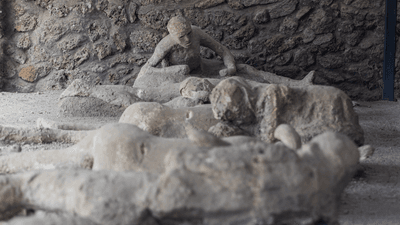


A team of researchers applying new techniques to old finds at Pompeii have been able to date the eruption more accurately than ever, potentially allowing scientists using the same methods to date other events in Earth's history with similar precision.
And it's all been given a little helping hand from Pliny.
Everybody has their favorite Pliny, and it is usually Pliny the Elder. But his nephew Pliny the Younger, who was educated by the OG Pliny, also has his merits. One of the things the Younger gave the world were two extraordinary letters describing his first-hand experience of the eruption of Mount Vesuvius in 79 CE.
Recording a disaster
Pliny the Younger's letters include an account of how his uncle attempted to soothe other residents of the city and move them to the shore to see if they could escape by sea. Unfortunately, Pliny the Elder suffocated on fumes whilst at the beach.
"My mother begged me to leave her and escape as best I could, but I took her hand and made her hurry along with me. Ash was already falling by now, but not very thickly. Then I turned around and saw a thick black cloud advancing over the land behind us like a flood," Pliny the Younger wrote of the eruption, per a translation, letting people of the future know the horror of what it was like to be there.
"'Let us leave the road while we can still see', I said, 'or we we'll be knocked down and trampled by the crowd'. We had hardly sat down to rest when the darkness spread over us. But is was not the darkness of a moonless or cloudy night, but it was just as if the lamps had been put out in a completely closed room."
Somewhat usefully, and more relevant to the new study, Pliny also marked down the date of the eruption as 24 August, 79 CE. For some time, that has been accepted as accurate.
But there are problems with this which make it not quite so clear-cut.
For example, autumnal fruits have been uncovered from Pompeii, as well as graffiti which reads (in Roman numerals, of course) October 17, in modern calendars. This has led some researchers to suggest that the eruption actually took place later in the year.
Crucially though, while the month might be wrong scientists generally agree that the year was accurate. New research is now showing that Pliny's account may be even more useful than we thought.
Using Pliny to ground truth modern science
A team from Berkeley Geochronology Center, UC Berkeley, and the University of Padua in Italy, have attempted to pin down the date of the eruption through other methods, to see if they could figure out the year themselves without the aid of Pliny.
The point of this was not to know the date of the eruption, but to use the eruption as a validation tool for a method using something called argon-argon dating.
"Dating past eruptions is trivial if reliable historical records are available, but, for prehistoric eruptions, researchers must rely on other methods such as 40Ar/39Ar dating," the team explains in their paper.
"Because Vesuvius’ 79 CE eruption is a near ideal case for 40Ar/39Ar dating at the limit of historical records, significant improvement over the existing ∼100 year uncertainty is clearly desirable."
Through improved mass spectrometry, and changes in experimental design, the team say that they have been able to provide a much more accurate and replicable picture of the date using argon-argon dating.
Using this method, the team puts the date of the eruption at 1,938 years ago, give or take 13 years. Pliny the Younger's writings place it at 1,946 years ago, meaning that the new argon-argon analysis was accurate to within 0.4 percent, with 0.7 percent uncertainty, which is unprecedented.
More accurate dating of the past
While we know the year of this eruption already, the implication is that this method could now be used to date other geological events, where nobody was helpful enough to write down a date (and no, not having invented writing yet is no excuse, ancient people).
"This lets us more precisely infer causality between events in the geologic record, for example a meteor impact structure and a mass extinction," study leader Paul Renne, a Berkeley professor in residence of earth and planetary science and director of the independent Berkeley Geochronology Center, said in a statement.
This is particularly impressive and useful. Generally the younger eruptions are harder to date using these methods, but it is precisely these younger eruptions and geological events which we want to assess volcanic hazards.
"If you want to put together the eruptive history of a volcano in relatively recent time, precision and accuracy really count," Renne added.
"The study shows that you can achieve that kind of highly useful precision and accuracy into the historical realm."
The study is published in Science Advances.