


 Space and Physics
 PUBLISHED


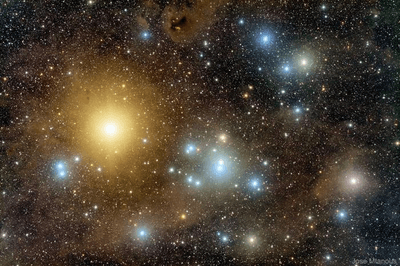


Evidence has been found of black holes a tenth of the distance of the previous closest observation to Earth. Moreover, unlike previous discoveries, this is one where anyone with access to moderately dark skies can stick out their finger and say, “They’re there.”
The Hyades Star Cluster is overshadowed in the public mind by the Pleiades, which proceed it across the sky during the Northern Hemisphere’s winter nights. That’s because the Pleiades are not just brighter, but much tighter. The Hyades are an older cluster, having had time to disperse quite a bit, but at 153 light-years away they’re also the closest star cluster to Earth.
The current record-holder for the closest black hole is Gaia BH1, some 1,600 light-years away. Reports of closer candidates have been refuted. However, stellar black holes form from the collapse of the largest stars, whose short lives usually take place entirely inside star clusters that haven’t had time to disperse. The Hyades is a logical place to look for closer examples.
Dr Stefano Torniamenti of the University of Padua led a team to measure the locations and movements of the Hyades’ stars to see if they were under the influence of unseen gravitational forces. "Our simulations can only simultaneously match the mass and size of the Hyades if some black holes are present at the centre of the cluster today (or until recently)," Torniamenti said in a statement.
The stars’ movements proved less helpful than hoped. However, attempts to use computer models to replicate the stars' distribution around the cluster’s center produced the best match, with two or three black holes still in the Hyades. Acceptable matches were also found when the black holes were assumed to have been ejected about 150 million years ago. That makes sense since the Hyades, thought to be 600-700 million years old, has already lost a substantial portion of its stars, either from random movements or an encounter with a neighboring mass.
"This observation helps us understand how the presence of black holes affects the evolution of star clusters and how star clusters in turn contribute to gravitational wave sources", said Professor Mark Gieles of the University of Barcelona.
The study was made possible by the exceptional precision with which Gaia can locate stars, particularly those as nearby (in galactic terms) as the Hyades.
Although the model suggests almost all surviving black holes in the cluster should have coupled up with stars, no candidate stars were identified with strong evidence of orbits around heavier objects.
There are several hundred stars in the Hyades, with a total mass around 400 times that of the Sun, but most require telescopes to see. However, the brightest members of the cluster form a distinctive V shape, completed by the much closer and brighter Aldebaran, which happens to lie in the same direction.
Most searches for stellar-mass black holes (as opposed to the supermassive type found at the center of galaxies) have concentrated on globular clusters in the Milky Way’s halo. Without that regular spherical shape, open clusters like the Hyades are harder to investigate. However, they can exist much closer to Earth, opening up exciting opportunities for study if the hunt proves successful.
The study is published in Monthly Notices of the Royal Astronomical Society.


