Culture and Society
 PUBLISHED


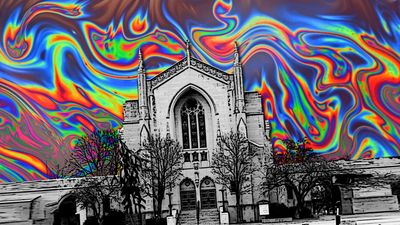


On April 20, 1962, people gathered in Boston University’s Marsh Chapel for a Good Friday service like no other. The congregation was there to take part in a novel experiment investigating religious and mystical experiences. While they sat in the chapel listening to the sermon from the pulpit, they were being observed by scientists who watched their every move. It was an unusual atmosphere to say the least and not what you’d normally expect from such a sacred event. But this was just the beginning.
Let us know what you think about your experience with The Vault: click here.
“As the chemical came over me, I began to be aware of a mounting disorder in the chapel,” Huston Smith said, recalling the strange events he had witnessed decades before.
“After all, half of our number were in a condition where social decorum meant nothing, and the other half were more interested in the spectacle that was unfolding than in the service proper. They were not above commenting on the spectacle and even joking about it among themselves.”
And then things took a turn for the dramatic. As the sermon continued in earnest despite the context, one person became overwhelmed by their own personal experience.
“[F]rom out of this bizarre mix,” Smith explained, “one of our number emerged.”
“He arose from his pew, walked up the aisle, and with uncertain steps mounted the chapel's modest pulpit. Thumbing through its Bible for a few moments, he then mumbled a brief incoherent homily, blessed the congregation with the sign of the cross, and started back down the aisle. But instead of returning to his pew, he marched to the rear entrance of the chapel and exited.”
Compelled by his ecstasy, the young man ran across the campus shouting his revelation to everyone present. His excitement caused a scene, as you can imagine, and resulted in a ruckus in the theology department’s stairway where he was restrained by Smith and some of the researchers after he attempted to steal a package off a passing postman (this happened, honestly).
As you’ve probably guessed at this point, Smith and the other experiment participants were under the influence of some mind-altering drug during the sermon. The study, remembered as the Good Friday Experiment or the Marsh Chapel Experiment, was designed to specifically investigate whether the use of psilocybin – the active psychedelic compound in “magic mushrooms”- could produce mystical or religious experiences in people.
The experiment is recognized today as a pioneering and astounding moment in the early research into the effects psychedelics can have on the mind. It was masterminded and conducted by Walter Pahnke, a Harvard Divinity School student who was also a psychiatrist and an ordained minister at the time.
Pahnke had a hunch that, when taken in a religious setting by those who were already religiously inclined, the substance would facilitate mystical experiences like those reported by people from across the world and throughout history.
He then developed a typology of religious/mystical experiences he assumed were universal (not unusual in this period, which tended to flatten cultural nuances in favor of assumed universality). This included the belief that such experiences included a sense of unity (internal and external), transcendence of space and time, a deep positive mood, sacredness, objectivity and reality, paradoxicality, alleged ineffability, transiency, and persisting positive changes in attitude and behavior.
Then, under the supervision of Dr Timothy Leary, a then leader in psychedelic research and later a controversial figure, Pahnke recruited 20 Protestant theology students. These students were split into two groups; one received psilocybin and the other was given a placebo – niacin, otherwise known as vitamin B3. However, it was designed to be a double-blind study, so neither the participants nor the researchers knew who was receiving the active or the control substance.
After this, the participants were split into pairs – one active, one control – based on their past religious experiences and backgrounds, as well as general psychological profiles. The researchers aimed to compare their scores. Participants were also put into five groups based on their compatibility. The aim here was to produce a comfortable, friendly environment so they could maximize their experiences.
The whole experiment was overseen by 10 other participants who were recruited to chaperone the others. Controversially, Leary insisted these participants also received a dose of either substance, which could have compromised the intention behind their role.
A few days before the Good Friday sermon took place, each group met up with their leaders to start forming social bonds. The hope was that these initial gatherings would put the participants in the best position to experience everything that was to come.
Profound experiences
“The Experiment was powerful for me,” Smith explained in an interview in October 1996, “and it left a permanent mark on my experiential world view.” He proceeded to explain that, for him, there is a difference between the experiential world – how you experience the reality around you – and how you think and believe the world is.
“For as long as I can remember, I have believed in God, and I have frequently experienced his presence in beauty, in nature, and (less frequently) in the clear light of the void that mystics speak of. But until the Good Friday Experiment, I had had no direct personal encounter with Him/Her/It of the sort that bhaktiyogis, Pentecostals, and born-again Christians describe. The Good Friday Experiment changed that, presumably because the service focused on God as incarnated in Christ.”
Clearly from Smith's perspective, the experiment was a success. Although, he did not experience the same “religious” excitement as the participant who charged from the chapel, the events of the experiment stayed with him for the next three decades. The results were similarly significant for many other participants who remained in the chapel. Nearly all who had taken the psilocybin experienced some or all of categories in Pahnke’s mystical typology, including profound unity, transcendence, and a deep sense of sacredness.
Although some members of the control group scored highly for one or two categories – one individual reported high scores for a sense of peace and sacredness – it was not to the same extreme as those who consumed the psilocybin.
Similarly, the man who ran through the campus later reported that the whole thing was the most profound experience of his life, transforming his view of spirituality. However, Pahnke omitted this person’s dramatic experience from his thesis. Instead, he briefly mentioned that two participants had “a little difficulty” recovering from the experiment while merely hinting that one participant had a psychotic episode without further comment.
Pahnke’s report and subsequent papers have been criticized for downplaying these points while also not sufficiently dealing with the exact details surrounding participants’ experiences. In 1991, a long-term follow up study was conducted by Rick Doblin, the founder of the Multidisciplinary Association for Psychedelic Studies. He found that the seven out of 10 active participants who responded still regarded the experiment as a positive experience with lasting influences on their worldview and spirituality.
Through an open-ended questionnaire, participants reported how the experiment not only helped them adopt positive behavior changes, but had also helped them resolve things like career decisions, as well as gaining a deeper connection to the divine or strengthening their faith.
But these overall positive results also revealed some complexities that Pahnke missed. In particular, Doblin’s study found that only two of the seven psilocybin participants had completely positive experiences. The others had struggled during the experiment, though they concluded that this added to their own growth. Nevertheless, this was not reported by Pahnke in 1963 when he submitted his thesis.
A difficult legacy
For the last decade or so, there has been a growing body of research into psilocybin and its psychological and clinical influences. However, this recent rise in interest comes after decades of neglect. During the 1960s and 70s, psilocybin and other psychedelics became too heavily associated with the contemporary counterculture and recreational drug scene, making it a taboo topic for academic interest.
The Good Friday experiment was criticized at the time for both ethical and methodological flaws, but ultimately it became too closely associated with the waning academic and public perception of psychedelics more generally. In 1963, Leary was dismissed from Harvard after his wider Psilocybin Project fell under repeated criticism for its approach, safety, and “moral” significance – mostly because he and his colleague Richard Alpert were accused of promoting the use of the drugs recreationally, rather than just as an experimental substance.
But rather than finding their careers in tatters, Leary and Alpert left academia to became active celebrities within the psychedelic movement. Leary became a famous counterculture personality and promotor of the drugs, coining the slogan “Tune in, Turn On, Drop Out”. Alpert, in contrast, adopted the name Baba Ram Dass, and published popular books on psychedelics and spirituality.
As for the Good Friday Experiment itself, it has had a complex legacy. Despite being wrapped up with the history of the 1960s drug scare, the experiment is now often remembered as a landmark in psilocybin research. It is regarded as offering compelling evidence of the potential power of psychedelic compounds and altered states of mind. But as Chris E. Corlett has recently noted, this may have only been news to the Western scientific community.
“[I]t is important to note that these compounds have been revered by indigenous societies around the world since before recorded history,” he writes.
“While many Western scientists and laypeople have claimed that psychedelics can lead to a revolution in everything from politics and human connection to psychotherapy, creativity, and existential dread, the power of these substances sometimes called plant medicines, has been known to other cultures for time immemorial.”
It will be interesting to see what future research in neuroscience and psychology makes of these substances as their popularity and acceptance continues to grow.
We want to know your thoughts on your experience so far with The Vault. Click here to have your say.