Space and Physics
 PUBLISHED


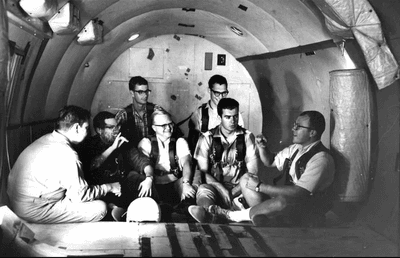


With the recent success of the Artemis II mission, there has been a lot of focus on human space exploration. Actor and Deaf activist Nyle DiMarco shared a reel on Instagram highlighting an important but not widely known group of people who played a pivotal role in getting to this point. They are the Gallaudet Eleven, 11 deaf men who underwent a series of experiments that allowed NASA to work out the effect of weightlessness on the human body.
Almost seven decades of humans in space, plus over 25 years of continuous habitation, have shown us how incredibly adaptable our bodies are to microgravity. Still, space takes a toll on the body. In the 1950s, however, it was not known what space would do to humans.
Being in orbit around Earth means you are in constant freefall. The apparent absence of gravity plays havoc with our vestibular system: a sense, located in the inner ear, that tells where we are, where our head is, and how to stay balanced. Without the obvious pull of gravity, that goes AWOL and can make people motion sick.
Across the late 1950s and early 1960s, NASA and the U.S. Naval School of Aviation Medicine established a research program to understand what was happening at a physiological level. They recruited 11 men from the then Gallaudet College (now Gallaudet University), the first school for the advanced education of the deaf and hard of hearing in the world, to take part.
Those people were Harold Domich, Robert Greenmun, Barron Gulak, Raymond Harper, Jerald Jordan, Harry Larson, David Myers, Donald Peterson, Raymond Piper, Alvin Steele, and John Zakutney. The Gallaudet Eleven were between 25 and 48, and all but one had become deaf early in their lives due to spinal meningitis. The disease is known to damage the vestibular system, and this meant that they did not get motion sickness.
For a decade, these men participated in experiments aimed at testing different motion extremes. One test had four of them living for 12 days in a slowly rotating room, going around 10 times a minute. In another, the men were placed in centrifuge pods spinning at high revolutions to simulate hypergravity. They also flew on parabolic flights, where microgravity is simulated by aiming the airplane down towards the ground; this is also known as the zero-g flight or the “Vomit Comet”.
They could do things that people with a functional vestibular system couldn’t, providing precious insights on how it all worked. In one notorious example, an experiment was planned to take place on a ferry in Nova Scotia crossing very choppy seas. While the members of the Gallaudet Eleven were unaffected and continued to play cards, the scientists got so seasick that they cancelled the experiment. They should have recruited a deaf scientist too!
“We were different in a way they needed,” Harry Larson, one of the volunteer test subjects, told NASA.
“In retrospect, yes, it was scary… but at the same time we were young and adventurous,” test participant Barron Gulak later remarked about the Ferry experiment.
“Through their endurance and dedication, the work of the Gallaudet Eleven made substantial contributions to the understanding of motion sickness and adaptation to spaceflight,” NASA described of the group.
More information about the Gallaudet Eleven can be found on Gallaudet University's website.