Technology
 PUBLISHED


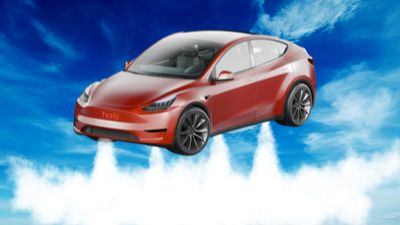


Almost a decade after it was announced, Tesla presented the Roadster 2, the new model of the company’s first vehicle. In a series of stunts, the car did something that Tesla CEO Elon Musk had long promised: it went airborne.
The car has been described as "flying", but not to be too Jennifer's Body about it, it looks more like "hovering" to us.
The vehicle was seen flying/hovering over Tesla’s Cybertruck as well as going up a large semi-circular ramp, flipping, and releasing bursts of steam as it came down, gently enough to land in one piece.
The carmaker will begin production in 2028, but how much of this stunt will make it into the purchasable vehicle remains to be seen.
Would you be able to drive it and fly it?
Elon Musk is not the first one to have thought of flying cars. They have been a staple of science fiction for many decades, and they have been promised to consumers for roughly the same amount of time.
Uber was working on them back in 2017 to have them in Los Angeles by 2020. The Klein Vision flying car that actually had a Certificate of Airworthiness from the Slovak Transport Authority announced that it would start selling flying cars this year. A recent announcement postpones new updates to next year.
There are certainly legal issues when it comes to a flying vehicle. The Federal Aviation Authority (FAA) requires a powered flying vehicle of more than 115 kilograms (254 pounds) to be registered, ask for clearance, and for its pilot/driver to have a license.
The FAA has approved test vehicles that sort of work as flying cars before, but they have been test vehicles. No one has gone to full production yet. Musk himself acknowledged the legality issue during the event: “I’m not sure it’s necessarily legal in all jurisdictions. This is not necessarily a safety-optimized car.”
States and cities might not allow vehicles to randomly take off and land whenever and wherever. Maybe, if that feature is actually included, it will only be able to be used from private land to private land (and with air traffic control clearance).
The physics of it all
Many online pointed out that while they dreamed of flying cars when they were children, the reality and practicalities of them make them unsuitable as realistic vehicles. A car having a malfunction stops. A flying car, having a malfunction, plummets to the ground.
The roadster was able to be airborne thanks to a composite-overwrapped pressure vessel (COPV) filled with nitrogen or compressed air at 10,000 PSI. The system sends the gas out to four nozzles, and they act as cold gas thrusters. The spinning and lateral movements are generated by additional COPVs and nozzles.
People have questioned the stunt itself with some of their queries being about the physics of it all.
In the semicircular ramp moment, the car appears not to be going fast enough to stick to the upper ledge. Apparently, Tesla used something called a "multi-mode suction system” to hold the car up.
Others have questioned how much this is hype over substance. Musk claimed that the Cybertruck would be able to cross rivers and be bulletproof, which turned out very much not to be the case. Will the Roadster 2 really fly, or just spurt some steam if you take a speed bump a bit too fast?