Nature
 PUBLISHED


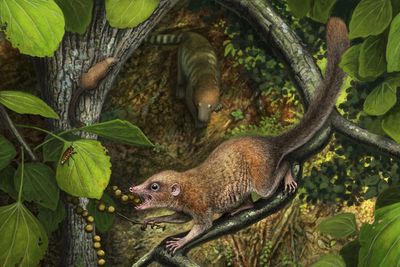


Researchers have unearthed the tiny, fossilized teeth of the earliest-known relative of primates, pushing its range further south than ever before and giving us new insights into how it spread through North America following the Cretaceous−Palaeogene extinction that wiped out the non-avian dinosaurs.
Finding the earliest representatives of a group of organisms, like primates, is a tall order, especially when they evolved tens of millions of years ago. The only way to classify them is to look for key features present in their descendants, yet these early species may be missing some or all of these characteristics, and the fossils are often fragmentary, making it hard to tell them apart from related species from diverging lineages.
That’s why Purgatorius – an ancient primate relative that emerged in North America around 65.9 million years ago – occupies a slightly uncertain place on the tree of life. You can imagine a fork in a branch of this tree. On one side are the primates, including lemurs, lorises, tarsiers, monkeys, and apes. On the other is the group that went on to produce flying lemurs and colugos. Purgatorius is thought to have budded off just before or just after this branch on the primate side, making it either a very early primate or a kind of protoprimate.
Whatever the case, it’s the most primate-y thing we know of that lived during the time just after the non-avian dinosaurs went extinct, so it can give us great clues to what our own ancestors were up to in this chaotic era, even if it isn’t quite one itself.
“The presence of these fossils in Colorado suggests that archaic primates originated in the north and then spread southward, diversifying soon after the mass extinction at the end of the Cretaceous Period,” said Stephen Chester at City University of New York, who led the study, in a statement.
The tiny creature, which would have been only around 15 centimeters (6 inches) long and around 30-100 grams (1-3.5 ounces), is known only from a few fragmentary fossils, but one of these is an ankle bone that indicates it was a tree-dweller. So, the researchers had initially thought its absence south of Montana could be due to a lack of trees following the devastation from the asteroid impact in Chicxulub, present-day Mexico, just a few hundred thousand years before.
“However, our paleobotanical colleagues suggested the recovery of plants in North America was fast, leading us to believe that Purgatorius should also be in more southern regions and perhaps we simply hadn’t looked hard enough,” said Chester.
And look hard they did. With the help of a device called the “bubbler”, which uses bubbles of air to help filter bone fragments from sediment, they carried out an extensive search in the Corral Bluffs area of Denver Basin, Colorado. This showed up countless fossils of fish, crocodilians, turtles, and eventually the tiny Purgatorius teeth, which would fit on the tip of a baby’s finger.
.jpg "Purgatorius upper molar from Corral Bluffs Denver Basin CO")
The teeth have some unique characteristics that mean they could be from an entirely new species of Purgatorius, but the researchers are waiting on more remains before they make that call.
The remains also demonstrate that the absence of early primate relatives in the interior of North America may be due to sampling bias, and there could be many more small fossils that were previously overlooked.
“Our results demonstrate that small fossils can easily be missed,” concluded Chester. “With more intensive searching, especially using screen-washing techniques, we will undoubtedly discover many more important specimens.”
The study is published in the Journal of Vertebrate Paleontology.