


 Technology
 PUBLISHED


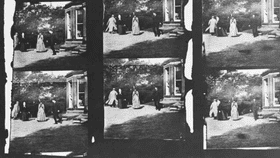


A YouTuber has used artificial intelligence to revamp the world’s oldest-known surviving pieces of film footage.
The original film, known as the Roundhay Garden Scene, was shot by French inventor Louis Le Prince on October 14, 1888. It shows a group of four people – including Joseph and Sarah Whitley, (Le Prince's parents-in-law), his son Adolphe, and Harriet Hartley (sometimes called Annie Hartley) – walking in a small circle around the Whitley's garden near the British city of Leeds. Le Prince is widely credited as the first person to record motion images on film, although he remains unknown nowadays perhaps due to his bizarre disappearance in 1890 (a bit more on that later).
Running at just a couple of seconds in length and shot at 12 frames per second, the black-and-white clip marks an incredible step forward in the development of technology. Just think: In 1888, Van Gogh was painting his masterpieces, Jack the Ripper was stalking the streets of East London, and the Eiffel Tower was still in the middle of construction. Although the film wouldn’t be winning any Oscars nowadays, 1888 was a very different world.
To revamp the legendary video, YouTuber Denis Shiryaev colorized and upscaled the frames of the original video using an ensemble of neural networks. As explained in the video, he started by obtaining the stills from the video on the Science Museum UK website collection. The individual frames were then centered using algorithms and their brightness levels were made more consistent. After adding a hint of color to the frames, neural networks were used to effectively “fill in the gaps” of the missing frames, giving the film a more realistic flow. From just 20 original frames, the work ended up with around 250 frames. Finally, ambient background sounds were added to give the film that little bit of extra depth.
The end result can be seen around the 2:40 mark in the video below.
Sarah Whitley, the older woman in the film, died 10 days after the scene was filmed. To further add to the spooky Vibes, Le Prince mysteriously disappeared in 1890 while on a train journey towards the French region of Dijon. His body and luggage were never found.
The YouTube channel has a bunch of equally impressive unscaled videos from the past 130 years, from the streets of Moscow in 1896 to Tokyo in 1913, so be sure to check it out.

 2
2