


 Culture and Society
 PUBLISHED


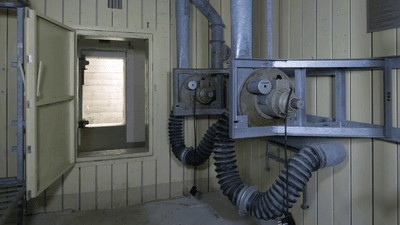


If there were to be a nuclear war on Earth, the best place to hide is usually touted as Australia or its smaller, more interesting friend New Zealand, largely due to their isolation, ample farmland, and position in the world, far from the heavily-armed Northern Hemisphere.
While those are certainly good options for those who wish to continue living under such a scenario, Switzerland is a pretty good bet too if you prefer more of a Silo or Fallout vibe for your post-apocalyptic shenanigans. The country, host to around 9 million people and with a long policy of military neutrality, has the most nuclear bunkers in the world.
During the Cold War between the US and the Soviet Union, Switzerland did not have much reason to believe that they themselves were a target in an escalations of the conflict. But nuclear fallout does adhere to borders, and the country began planning for the worst case scenario in which radiation from a nuclear strike began drifting across Europe.
"Switzerland developed a visionary and globally unique concept: the nationwide construction of robust, simple, and cost-effective shelters, intended to enable the Swiss population to survive underground in the event of a nuclear war in Europe," the Swiss Federal Office for Civil Protection explains.
"Until the end of the Cold War, the construction of shelters and the planning and organizational preparation for extended stays within them remained central to civil defense."
During the Cold War, the country was host to a number of very large bunkers.
"Back then, 20,000 people constituted a third of our city's inhabitants," Sonnenberg Bunker guide Zora Schelbert told NPR of the Sonnenberg Bunker, built in the 1970s.
"So every third person in the city of Lucerne was once supposed to be sheltered in this bunker."
With only a few weeks' supply of diesel, the bunker would be out of power within a few weeks, making any Fallout scenarios pretty short-lived in the event of an actual attack.
Thankfully, these Cold War-era bunkers were never tested in real-world circumstances.
After the Cold War ended, you might think that Switzerland would cool it down a little, but that was not the case. Instead, Switzerland committed to an "a shelter for every inhabitant" policy, ensuring that the country has more than enough capacity to shelter every single one of its inhabitants (though coverage is better in some areas than others).
These shelters, whilst designed to be pretty basic to minimize costs and maintenance costs, are made with reinforced concrete, come with blast doors, and have their own escape tunnels should the usual entranceway become blocked.
As well as this, each bunker is equipped with a ventilation system, whilst larger bunkers come with additional airlocks, preventing air from the outside from getting in.
"Shelters are standardised and built with tested components. Moreover, they can have different sizes and floor plans," the Swiss Federal Office for Civil Protection explains.
"The number of places a shelter offers depends on its size. The best-known examples are private shelters in the basements of detached houses or apartment buildings. This will generally offer places for 5 to 50 occupants, depending on the size of the house or apartment block. Many communities also have major public shelters (e.g., under schools or administrative buildings), which may offer several hundred places."
There was some discussion of ending this policy in 2010 and 2011, but when the Fukushima disaster happened the country decided to carry on as they were, just in case. Building developers must either construct a bunker, or contribute money to a nearby communal bunker maintained by the state.
It may seem a little bit retro to be building nuclear bunkers this far from the Cold War, but with the escalating tensions and outright wars going on at the moment, the country has committed to replace older bunkers and their components, increase contributions towards the bunkers, and adjusted obligations for developers to build these shelters.
"Over the past 60 years, Switzerland has developed a comprehensive protective infrastructure for its population, command authorities, and civil defense. The changing global security situation, particularly the ongoing war in Ukraine and other regional conflicts, underscores the importance of such infrastructure for the Federal Council. These developments demonstrate that armed conflicts remain a real threat in the 21st century," the Swiss government explained in a statement.
"With the amendments to the Civil Protection Ordinance (ZSV), the Federal Council is maintaining Switzerland's resilience in the event of an armed conflict."
Fingers crossed they will never be needed, and the Swiss can continue to use them for storage, as wine cellars, and, sometimes, as a sauna.



 3
3