Nature
 PUBLISHED


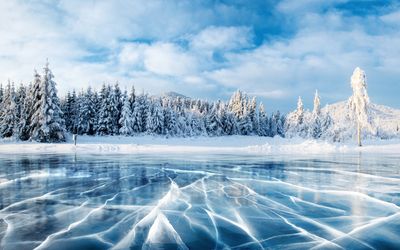


Life in a lake can be challenging at the best of times, but with winter comes another hurdle – ice. With the surface of lakes freezing over, light and oxygen suddenly become a lot more limited. That could be a potential threat, but thankfully, lake-dwelling organisms have come up some cool ways to survive.
Metabolic changes
Fish, as it turns out, are a bit like us when it comes to the winter months; they get less active. That’s because they’re cold-blooded (not like us), meaning their metabolism slows right down when the lake’s temperature gets cooler.
They’re also helped out by the layer of ice on the surface providing some insulation. The resulting relatively warmer water below the ice is dense and so sinks to the bottom of the lake, where fish then cozy up together and chill out for winter. Certain species, such as koi and gobies, have the ability to embed themselves in soft sediments and enter a state of dormancy. During this time, their heart rate lowers, they don’t need as much food and oxygen, and they don’t move about much.
Plenty of other creatures outside of water use similar tricks to survive winter, too. It’s why you should probably take a helmet with you if you go to Florida in the cooler months, just in case of sleepy, falling iguanas.
Built-in antifreeze
You’ll find a lot more than fish in a frozen-over lake and arguably, it’s the resident insects who have the coolest methods for surviving the bitter temperatures.
Some insects have a type of antifreeze in their cells. Like nature’s equivalent to the strong-smelling canned stuff you spray on your windscreen, this cryoprotective substance is made from specialized carbohydrates that lower the freezing point of their bodily fluids. This stops ice crystals from forming, which might otherwise cause the insect’s cells to burst, leading to fatal damage.
Other insects, however, just suck it up when it comes to freezing and have adapted to let the ice crystals do their thing. Lake-dwelling insects such as dragonfly larvae and waterboatmen produce proteins that help to control the freezing process, known as ice nucleators. This helps to stop the ice crystals from damaging their cells by essentially freeze-drying them.
Do lakes need to freeze over?
For a decent number of lakes, freezing over is all part of a bigger, crucial process. Known as lake turnover, the water in the lake literally turns over from top to bottom, with the surface layer being hottest in the summer and coldest in the winter. This process is important for the distribution of oxygen throughout the lake’s waters, allowing for respiration to occur and thus, organisms to survive.
This is why it’s also important for lakes to melt and continue the turnover process. Once sealed off by ice, the situation becomes something akin to a plot point found in many a clichéd survival movie – there’s suddenly a finite amount of oxygen and it gradually depletes.
Lakes might have phytoplankton (albeit at lower levels during winter), which would normally take carbon dioxide and produce oxygen via photosynthesis, but that requires light, which is also in pretty short supply. If the lake stays frozen over for too long, organisms will start to die from a lack of oxygen – even if they’ve adapted to use less of it, like fish, they still need some amount to live.
Lack of oxygen can also occasionally lead to “winterkill” in smaller frozen-over lakes. As plant life dies off, what little oxygen is left can lead to decomposition, decreasing oxygen even further in the process and consequently, killing off even more organisms.
With climate warming, that might not be a problem – many lakes are melting earlier than ever and some are not freezing over at all. That might sound like a positive for lake residents, but it may well disrupt the delicately balanced turnover process and in turn, the oxygen and nutrients they need to survive.
All “explainer” articles are confirmed by fact checkers to be correct at time of publishing. Text, images, and links may be edited, removed, or added to at a later date to keep information current.